
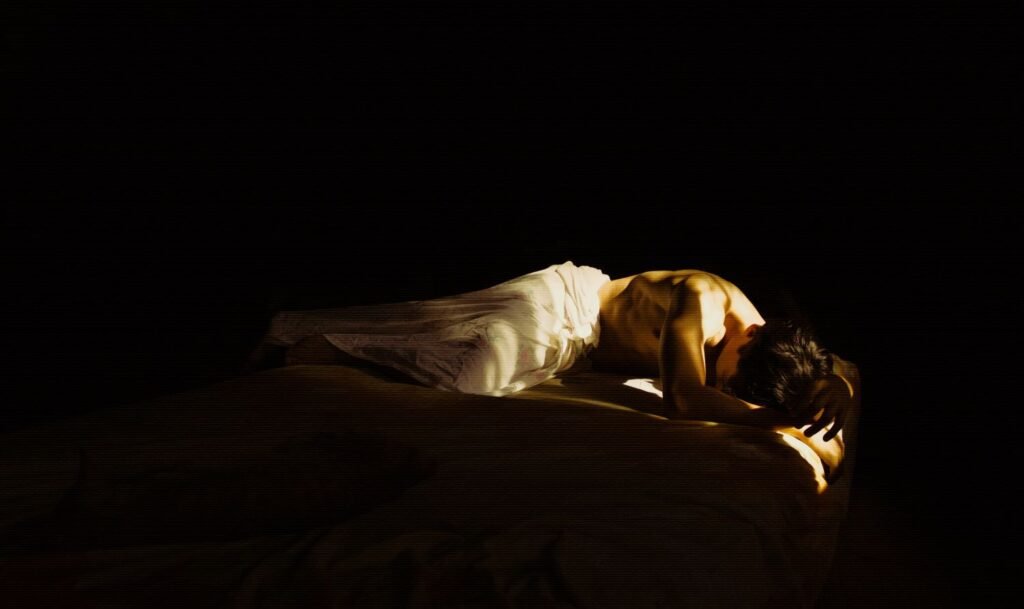
Are You Conscious During Dreamless Sleep? The Question That Complicates Everything We Think We Know About Awareness
Does consciousness vanish in dreamless sleep, or just leave no trace? A clear-eyed look at the science and contemplative claims about sleep awareness.
Table of Contents
- The eight hours you can’t account for
- What “consciousness during dreamless sleep” actually means
- What this idea is NOT
- No memory vs. no experience: the distinction everything hinges on
- What contemplatives claim, and what sleep science is actually finding
- The honest, harder truth about a question that may not have a clean answer
- How to actually investigate your own sleep
- The reframe: the gap in your story might not be a gap in you
The Eight Hours You Can’t Account For
Try this: describe, in detail, what it was like to be you at 3 a.m. last night.
You can’t. Not because your memory is bad — because there’s nothing there to remember. No scene, no feeling, no flicker of “I was here.” As far as your recollection is concerned, you handed over consciousness around the time your head hit the pillow and got it back, slightly used, when the alarm went off.
Here’s the uncomfortable part: that blank isn’t proof that nothing was happening. It’s just proof that nothing got stored. And once you sit with that distinction for more than a few seconds, an entire third of your life turns into a locked room you’ve been assuming is empty without ever actually checking.
This piece checks. Not by asking you to take anyone’s word for it — not the yogis, not the neuroscientists — but by walking carefully through what’s actually known, what’s genuinely still open, and where the two camps agree more than either side usually admits. By the end, you’ll understand exactly why “dreamless sleep” turned out to be one of the strangest unsolved puzzles in consciousness research, and you’ll have a way to start investigating your own nights instead of just wondering about them.
What “Consciousness During Dreamless Sleep” Actually Means
Sleep researchers divide the night into rough stages: light sleep, deep slow-wave sleep, and REM sleep, where most vivid dreaming happens. For most of the 20th century, the working assumption was blunt — REM is where the movie plays, and deep slow-wave sleep is the projector switched off entirely. Lights out, nobody home.
The claim under investigation here challenges that second half. It’s not about dreaming (that’s a related but separate mystery). It’s the narrower, stranger question: during the stages of sleep with no dream content at all — no imagery, no story, no sense of a body moving through a scene — is there still someone there to not-experience anything? Or is the lack of content the same thing as a total lack of experience?
A useful way to feel the difference: think about the gap between a radio that’s off and a radio that’s on, tuned to static, volume at zero. From the outside, both look and sound identical — silence. But structurally, they’re completely different states. One has no circuit running at all. The other has a fully live circuit that simply has nothing coming through it right now.
The question this article is chasing is whether dreamless sleep is more like the radio switched off, or the radio switched on with the volume at zero — awareness itself intact, running quietly, with nothing currently showing up in it.
This isn’t idle philosophizing. Consciousness researchers have specifically flagged deep sleep, alongside lucid dreaming and the sleep-wake transition, as one of the most information-dense natural laboratories available for studying what awareness actually requires to exist — precisely because it strips almost everything else away.
What This Idea Is NOT
It’s not the same as lucid dreaming. Lucid dreaming — knowing you’re dreaming, while still inside a dream — gets a lot of pop-culture attention, and it’s genuinely fascinating. But it involves rich content: scenery, a body, often a plot. Dreamless-sleep awareness, if it exists, is closer to the opposite extreme — reportedly bare, with no dream-world attached to it at all. Don’t confuse the two; they’re addressing different layers of the sleep mystery.
It’s not the same as “half-awake” grogginess. That fuzzy, can’t-quite-think state right as you’re drifting off or dragging yourself up is called the hypnagogic or hypnopompic state, and it’s well documented — partial wakefulness, partial sleep, often with fragmented imagery. It’s a real and interesting zone, but it’s not what contemplatives are pointing at when they describe stable awareness continuing through the deepest part of sleep. That claim is more radical: not a blurry border zone, but clarity persisting exactly where you’d expect none at all.
It’s not a claim that you’re “consciously experiencing your life” while asleep. Nobody serious is arguing you’re planning your week or feeling your bedsheets in deep sleep the way you would awake. If anything remains, contemplative accounts describe it as something closer to bare, contentless presence — no narrative, no self-reflection, no “I am asleep and aware of it” running commentary. That kind of self-aware framing is itself a form of content, and it’s usually described as showing up after, upon waking, not during.
It’s not settled science, in either direction. This is worth saying plainly because a lot of spiritual content skips it: there is no definitive brain scan that lights up and proves “consciousness present” during dreamless sleep the way a heart monitor confirms a heartbeat. What exists is suggestive, carefully collected evidence and a live scientific debate — not a verdict.
No Memory vs. No Experience: The Distinction Everything Hinges On
Why “I don’t remember it” isn’t the same as “it didn’t happen”
You’ve had this experience already, just not at 3 a.m. — think of anesthesia. People who undergo general anesthesia sometimes report, upon waking, a sense that “no time passed at all,” total blankness. But we know from monitoring that the brain was doing enormously complex things throughout the procedure; the drug was specifically disrupting memory formation and certain integration processes, not necessarily obliterating every flicker of experience in the way patients later assume.
Or a gentler, everyday version: you’ve probably driven a familiar route on autopilot and arrived with almost no memory of the drive itself. Nobody assumes you were unconscious behind the wheel — clearly some form of processing, awareness of the road, split-second reactions were happening. It just didn’t get written to long-term memory because nothing about it demanded to be remembered.
Memory formation and conscious experience are handled by at least partially separate systems in the brain. That’s not a fringe claim — it’s basic, well-established neuroscience. Which means the total blankness you feel about your night’s deep sleep is, strictly speaking, evidence about your memory system’s activity during that window. It is not, by itself, direct evidence about whether experience was present.
Why that reopens the sleep question instead of closing it
This is the hinge the whole topic turns on. If “I don’t remember X” automatically meant “X involved no experience,” then the anesthesia case above would be settled, dreamless sleep would be settled, and there’d be no research field here at all. Instead, researchers treat the memory/experience gap as a genuine open door — and they’ve started building ways to look through it that don’t rely on someone waking up and trying to recall a blank.
What Contemplatives Claim, and What Sleep Science Is Actually Finding
What meditative traditions have claimed for a very long time
Several contemplative systems explicitly describe sleep as having more structure than “on” and “off”:
- Yoga philosophy names deep dreamless sleep sushupti, listed as a distinct state of consciousness in its own right (alongside waking and dreaming) — not an absence of consciousness, but a specific, describable mode of it, sometimes characterized as contentless bliss or peace.
- Tibetan Buddhist dream and sleep yoga trains practitioners across years to maintain what’s called “the luminosity of deep sleep” — deliberately cultivating a thread of awareness meant to persist through the deepest, most dreamless part of the night, treated in these traditions as an advanced and difficult practice, not a beginner default.
- Advaita Vedanta, again, treats deep sleep as one of the three ordinary states (waking, dreaming, deep sleep) all resting on a fourth, background awareness — meaning deep sleep isn’t framed as an absence of the witness, just an absence of objects for it to witness.
Does the science that mystical claim to have observed this need to be true? Not necessarily — but here’s the part serious science writing about this topic has to hold carefully: independent traditions converging on a similar structural claim (deep sleep as a distinct, trainable, potentially aware state) is an interesting pattern worth investigating, not proof the metaphysics behind it is correct.
What is actually being measured
Long-term meditators and post-sleep reports. Some studies working with highly experienced meditators have found that these practitioners more frequently and more confidently report a sense of awareness “having been present” during polysomnographically confirmed deep sleep, compared to non-meditators — using structured interviews immediately upon waking, rather than relying on vague next-morning recollection. This is genuinely one of the more interesting empirical threads in contemplative neuroscience right now.
EEG patterns that don’t fit the old binary. Deep, dreamless slow-wave sleep isn’t neurally uniform. Researchers have identified micro-patterns and localized activity within slow-wave sleep that look different depending on what’s reported afterward — hinting that “dreamless sleep” may not be one single state, but a family of related states, some more compatible with a shred of ongoing awareness than others.
Lucid dreaming as a stepping-stone tool, not the topic itself. Because lucid dreaming provides a rare bridge where a sleeping brain can still signal something to the outside world (via pre-agreed eye movements, for example), some researchers use it as a training ground and methodological proof-of-concept for the broader idea that sleep states can carry more structured awareness than assumed — even though lucid dreaming itself is a REM, content-rich phenomenon, distinct from dreamless deep sleep.
What none of this amounts to yet: a clean, universally accepted “yes, awareness definitely persists in deep sleep” finding. What it amounts to is a research field taking a question seriously that used to be dismissed as obviously settled — and finding the old binary (conscious/unconscious, on/off) is a worse fit for the data than a spectrum.
“The absence of a memory is not the same shape as the absence of an experience — and sleep science has started building its questions around that difference instead of around the old on/off switch.”
The Honest, Harder Truth About a Question That May Not Have a Clean Answer
Most articles on this topic build toward a tidy conclusion. This one won’t, because the tidy conclusion isn’t available yet, and pretending otherwise would be the least honest thing this piece could do.
First: the evidence so far leans heavily on self-report, and self-report about sleep is uniquely tricky. Unlike reporting on a waking experience seconds after it happens, sleep reports always involve some kind of transition — waking up, however briefly — before the report can be given. That transition itself changes brain state. Researchers are working hard to minimize this gap, but it can’t be fully eliminated with current tools, and that’s a real limitation, not a minor technicality.
Second: “trained meditators report more awareness in deep sleep” doesn’t automatically mean untrained people have none. It might mean the opposite: that everyone has some baseline capacity here, and years of specific practice simply make it reportable — turning something that would otherwise be forgotten the instant you wake into something that survives the transition back to waking memory. The training might be building a bridge to something, rather than manufacturing something from nothing. Nobody currently knows which, and it matters enormously for how you interpret the whole topic.
Third: this question might be genuinely, structurally hard to ever fully answer — not just hard with today’s tools. The core difficulty is almost logical, not just technical: any method you use to check “is there experience happening” during a state defined by lacking reportable content is going to run into the same wall — the moment you get a report, you’ve arguably pulled the person partway out of the very state you were trying to check. This doesn’t mean the question is meaningless. It means it might belong to a small category of questions where certainty is permanently just out of reach, and the honest response is comfort with that, not a manufactured resolution.
Fourth: be suspicious of anyone offering total certainty here, in either direction. The person confidently telling you “science has proven awareness continues through deep sleep” is overselling the data. So is the person confidently telling you “we know for a fact nothing is happening — it’s just biology switching off.” Both are compressing a genuinely unresolved, actively studied question into a punchier sentence than the evidence supports.
How to Actually Investigate Your Own Sleep
You can’t run a polysomnography lab from your bedroom, but you can start collecting your own first-person data — carefully, without over-claiming what it proves.
- Start with the transition, not the deep sleep itself. Before targeting the hardest part of the puzzle, get familiar with the easier edge: the few seconds right as you’re falling asleep, and right as you’re waking up. Keep a notepad by the bed. The instant you wake — before checking your phone, before your mind starts narrating the day — ask: was there anything there, even a texture, a sense of duration, anything at all, before this thought? Write down whatever comes, even “nothing” or “not sure.”
- Watch for a felt sense of duration. One of the more interesting informal markers meditators describe isn’t imagery — it’s a rough, wordless sense of how long the sleep felt, distinct from what the clock says. A night that felt like “no time passed” versus one that felt like it “had some quiet length to it,” even without content, is itself a data point worth logging.
- Try a pre-sleep intention practice, without expecting fireworks. Some sleep-and-dream traditions use a simple mental “seeding” technique before sleep — quietly intending, as you drift off, something like may awareness continue. This isn’t a magic switch. Most nights, nothing notable will register. The value is in the noticing habit it builds for the mornings when something does.
- Track patterns over weeks, not one night. A single morning of “huh, weird, I think something was there” proves very little on its own — it could be a half-remembered dream fragment, a hypnagogic sliver, or just an interesting guess your brain made after the fact. A pattern building up over several weeks of careful, honest logging is far more informative than any single dramatic morning.
- Stay skeptical of your own reports, especially the exciting ones. The mind is extremely good at retroactively constructing tidy stories. If a report feels too clean, too dramatic, too on-the-nose for what you were hoping to find — that’s worth extra scrutiny, not extra excitement. Good self-investigation here means holding your own data the way a careful scientist holds it: interested, but not attached to a particular outcome.
The Reframe: The Gap in Your Story Might Not Be a Gap in You
Here’s the quiet unsettling thing under all of this: you’ve been walking around with a third of your life filed under “nothing happened here,” purely because nothing got written down. That’s a strange thing to have accepted so completely, for so long, without ever checking the paperwork.
Maybe deep sleep really is the lights-out, nobody-home state most of us assume — a clean, total pause. That would be a perfectly reasonable place for the evidence to eventually land. But maybe it’s closer to a radio left on, volume at zero, circuit humming quietly under a silence that only looks like absence from the outside — and from the inside, too, once memory declines to keep the receipt.
Either way, the honest version of this story isn’t “science has revealed the secret of sleep.” It’s smaller and more interesting than that: a question everyone assumed was closed turns out to still be open, and it’s your own nights sitting there, unexamined, as the actual evidence.
You don’t have to resolve it tonight. You just have to notice, tomorrow morning, that there might be something worth asking about at all.
A short author’s note: The hardest part of writing this piece was resisting the urge to give you a bigger ending than the evidence earns. It would have been easy to close with “and science now confirms consciousness never truly sleeps” — it’s a great sentence, and it’s not one anyone can honestly write yet. What I can say is that the question is being taken seriously by people with EEG machines and decades of contemplative training alike, which is rarer and more interesting than a tidy answer would be. If this stirred something for you, the companion piece on pure, contentless awareness while awake is a natural next stop — same underlying mystery, different door in.
Related Articles

Personal Transformation
Purpose vs. Passion: Why What You Love and What Gives Your Life Meaning Are Not Always the Same Thing
Purpose vs. Passion: Why What You Love and What Gives Your Life Meaning Are Not Always the Same Thing Purpose and
September 12, 2026
No Comments

Meditation
When Meditation Stops Feeling Relaxing: Why a Deeper Practice Can Actually Feel Harder
When Meditation Stops Feeling Relaxing: Why a Deeper Practice Can Actually Feel Harder Meditation not relaxing anymore? Discover why deeper
September 3, 2026
No Comments

Awakening
Dark Night of the Soul
The Dark Night of the Soul: 13 Signs You’re in It—and What Actually Helps When your old identity, meaning, and
August 15, 2026
No Comments

Manifestation
Do Affirmations Actually Work? Why Some Feel Powerful—and Others Make You Feel Worse
Do Affirmations Actually Work? Why Some Feel Powerful—and Others Make You Feel Worse Do affirmations work? Explore why some positive
September 7, 2026
No Comments

WellBeing
Holistic Wellbeing for Skeptics: What’s Actually Evidence-Based—and What Deserves More Questioning
Holistic Wellbeing for Skeptics: What’s Actually Evidence-Based—and What Deserves More Questioning Is holistic medicine evidence based? We examine meditation, yoga,
September 1, 2026
No Comments

WellBeing
Why Your Spiritual Practice Can’t Replace Sleep: The Overlooked Foundation of Higher Wellbeing
Why Your Spiritual Practice Can’t Replace Sleep: The Overlooked Foundation of Higher Wellbeing Meditation can’t fix what sleep deprivation breaks.
September 10, 2026
No Comments