
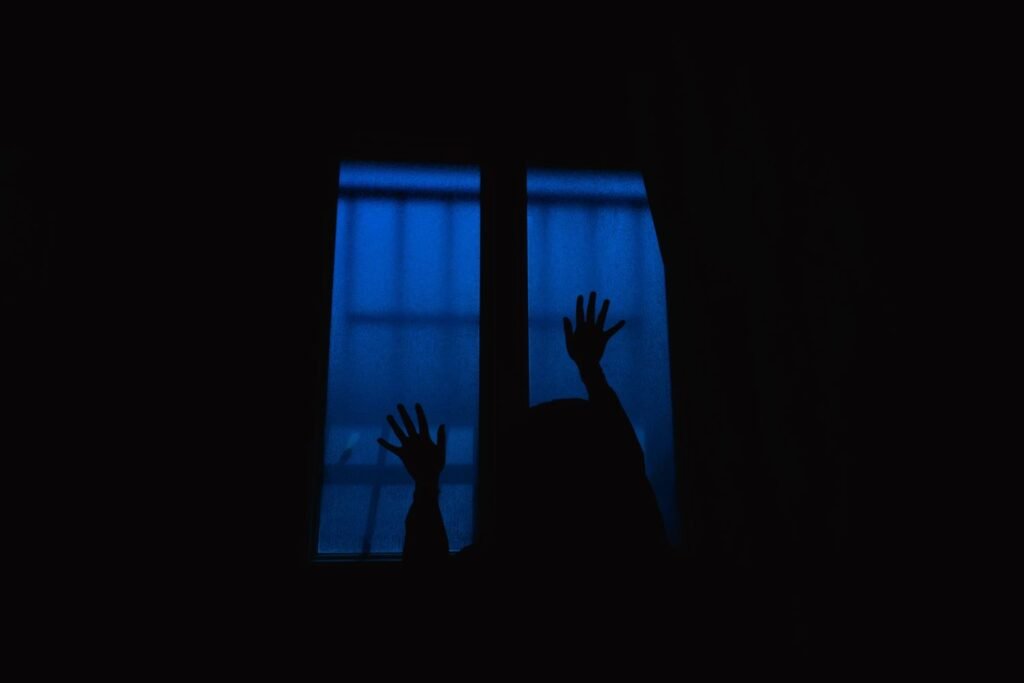
Sleep Paralysis Demons Look Remarkably Similar Across Every Culture on Earth — Here’s the Leading Theory Why
Sleep paralysis visitors look eerily similar worldwide — a shadow figure, a weight on your chest. Here’s what neuroscience says is happening.
Table of Contents
- Awake, and unable to move
- What this piece will actually give you
- What’s happening, in plain language
- What it’s NOT
- The same figure, in cultures with zero contact with each other
- Why the brain produces a “presence” specifically
- The honest, harder truth: understanding it doesn’t make it less terrifying
- What actually helps — before, during, and after an episode
- Author’s note
Awake, and unable to move
You surface out of sleep, and something is immediately wrong. You’re awake — genuinely, fully awake, aware of your room, your bed, the time — but your body won’t respond. You try to move your arm and nothing happens. You try to call out and no sound comes.
And then, for a lot of people, it gets worse: a sense that you are not alone. Sometimes a shape at the edge of the room. Sometimes a weight pressing on your chest. Sometimes nothing you can see, just an overwhelming, specific certainty that something is there, watching, close.
If you’ve had this happen, you don’t need this article to convince you it was real. It was real — your body was genuinely paralyzed, your fear was genuinely triggered by something your brain was genuinely doing. What this piece will do is show you what that something actually is, and why people across entirely disconnected cultures, with no contact with each other, describe the exact same experience in strikingly similar terms.
What This Piece Will Actually Give You
This article treats sleep paralysis as what it is: a well-documented, genuinely common neurological state, taken seriously both as a frightening lived experience and as a fascinating cross-cultural phenomenon. You’ll get the leading scientific explanation for why it happens and why the “presence” specifically shows up so consistently across cultures that never had contact with each other, plus practical, evidence-based guidance for reducing how often it happens and getting through an episode if it does.
This isn’t going to tell you the fear wasn’t warranted, or that understanding the mechanism will make future episodes feel calm. It won’t. What it will give you is something almost as valuable: the knowledge that this is a known, studied, survivable, and remarkably common human experience — not a sign that something is wrong with you specifically.
What’s Happening, in Plain Language
Here’s the core mechanism: during REM sleep — the phase where most vivid dreaming happens — your brain deliberately paralyzes most of your voluntary muscles. This is called REM atonia, and it exists for a genuinely good reason: without it, you would physically act out your dreams, which would be dangerous for you and anyone near you.
Sleep paralysis happens when that paralysis persists for a brief window after your conscious mind has already woken up. You’re awake — genuinely alert, aware of your surroundings — but your body hasn’t caught up yet and is still locked in the REM-sleep paralyzed state. That mismatch, a waking mind trapped in a sleeping body, is the entire mechanical basis of the experience.
The hallucinated presence is a separate but related piece: the same brain regions responsible for generating dream content and for threat detection appear to remain partially active during this transitional state, layering vivid, often frightening hallucinated content on top of the very real, very disorienting physical paralysis. You’re not imagining the paralysis. You’re not imagining that something felt present. Your brain, caught between two states it’s not built to be caught between, is generating a genuinely convincing experience out of real, identifiable neurological activity.
What It’s NOT
A few important boundaries before going further.
- This is not a rare or abnormal experience. A substantial portion of the general population reports experiencing sleep paralysis at least once, and it’s especially common during periods of sleep deprivation, disrupted sleep schedules, or sleeping on your back — worth normalizing directly, since a lot of the distress around a first episode comes from feeling like an outlier.
- This is not something the leading theory claims to fully, completely resolve. The general mechanism (REM atonia persisting into waking awareness) is well-supported. The specific reason the hallucinated content so consistently takes the form of a humanoid presence, rather than something else entirely, is still an area of active research — this piece will be direct about what’s solid and what remains genuinely being worked out.
- This is not a symptom you should be embarrassed about, or a sign of a serious underlying mental health condition, for the vast majority of people who experience it. Isolated, occasional sleep paralysis is common in the general population; frequent, severe, or highly distressing episodes are worth mentioning to a doctor, but a single frightening episode isn’t cause for alarm about your overall health.
- This is not the same experience as a nightmare. Nightmares happen while you’re still asleep. Sleep paralysis specifically involves a period of genuine, conscious wakefulness combined with physical paralysis — that combination is what makes it so distinctly terrifying compared to an ordinary bad dream.
The Same Figure, in Cultures With Zero Contact With Each Other
This is the detail that makes sleep paralysis one of the most genuinely striking cross-cultural phenomena in psychology, and it’s worth sitting with in some detail.
In parts of Newfoundland and other regions of English folklore, the experience has historically been described as an encounter with “the Old Hag” — a figure who sits on the sleeper’s chest, producing the characteristic sensation of pressure and inability to breathe or move, giving rise to the term “hag-ridden.”
In parts of Southeast Asia, comparable accounts describe a similar experience with regionally specific folkloric figures associated with pressing weight and paralysis during sleep — accounts that predate any significant contact with English-language “Old Hag” folklore.
In some West African and Caribbean traditions, similarly structured accounts exist under different regional names, again describing the combination of paralysis, chest pressure, and a sensed malevolent presence.
In modern Western pop culture, particularly since the mid-20th century, a substantial number of sleep paralysis accounts have been described using the language of alien abduction — a humanoid or non-human figure present in the room, an inability to move, sometimes a sense of being examined or acted upon.
In modern shadow-figure accounts, especially widely reported online in the past two decades, the presence is frequently described specifically as a dark, human-shaped silhouette standing at the periphery of vision, sometimes near a doorway or the foot of the bed.
Across every one of these traditions — separated by centuries, oceans, and, in several cases, genuinely no plausible cultural contact — the core structural elements repeat with remarkable consistency: an inability to move, a sense of pressure or weight, and a specifically humanoid, specifically aware presence, rather than a vague or abstract sense of wrongness. That specific convergence, across cultures with no shared source material, is what makes this a genuinely interesting scientific and cultural question, not just a spooky story.
Why the Brain Produces a “Presence” Specifically
The leading explanation ties back to the same overlapping brain systems mentioned earlier: as you surface into partial wakefulness while REM atonia persists, the brain’s threat-detection systems — normally quite active during REM sleep, where they help generate dream conflict and danger — appear to remain partially engaged even as conscious awareness returns. A brain that is simultaneously (a) aware it cannot move and (b) running heightened threat-detection processing is, in a very real sense, primed to interpret that vulnerable, immobilized state as evidence of an external threat, and to construct a specific, humanoid form for that threat, consistent with how human threat perception works even in fully waking contexts (people are very reliably good at — and quick to — perceiving human and human-like shapes, sometimes where none exist, a well-documented perceptual bias that operates outside sleep paralysis too).
Put simply: a nervous system that is (1) unable to move, (2) newly conscious, and (3) still running dream-adjacent threat-generation machinery is about as primed as a brain can be to produce the specific, convincing experience of “something is here, and it means me harm” — and it appears to do so with remarkable consistency across completely different cultural contexts, because the underlying neurology producing it is the same underlying human neurology everywhere.
This remains an area of active research rather than a fully closed case — researchers continue to study exactly why the hallucinated content takes such a consistently humanoid, specifically aware-of-you form rather than some other kind of content, and there’s genuine scientific interest still active in pinning down the precise mechanism further.
The Honest, Harder Truth
Here’s what most explainer content about sleep paralysis gets wrong, in a way that can actually feel dismissive to people who’ve lived through it: explaining the neuroscience accurately does not make the experience less terrifying, and content that implies it should is quietly failing the people it’s trying to help.
Knowing, intellectually, that REM atonia and threat-detection overlap are producing the sensation does not turn off your amygdala in the actual moment. People with advanced degrees in exactly this area of neuroscience still report their own sleep paralysis episodes as viscerally, overwhelmingly frightening, even while fully understanding the mechanism as it happens to them. That’s worth stating plainly, because a lot of content in this space implicitly promises that understanding will neutralize the fear, and that promise sets people up to feel like they’re doing something wrong when a full scientific understanding doesn’t stop their heart from racing during the next episode.
There’s a second, related truth worth naming: taking the neuroscience seriously and taking the felt experience seriously are not in tension, and treating them as though they were is a mistake this piece is trying specifically to avoid. You can fully accept that REM atonia and threat-detection overlap explain the mechanism, and still have the actual lived experience be one of the most frightening things that’s ever happened to you. Both are true. Neither cancels the other out. Content that leans too hard on “it’s just neuroscience, nothing to be afraid of” is, in its own way, doing the same flattening thing that dismissing any frightening experience with a tidy explanation always does — it prioritizes the reader’s intellectual reassurance over actually validating what the experience was like for the person who lived through it.
What Actually Helps — Before, During, and After an Episode
Practical guidance, grounded in what’s actually understood about sleep paralysis risk factors and management.
Reducing frequency:
- Sleep position matters. Sleeping on your back is associated with a meaningfully higher likelihood of sleep paralysis episodes than sleeping on your side; if you experience frequent episodes, side-sleeping is a reasonable, low-effort first change to try.
- Sleep deprivation and irregular sleep schedules are well-established triggers. Consistent sleep timing and adequate total sleep are among the most reliably effective preventive measures available.
- High stress and disrupted sleep architecture (including some medications and substance use patterns) increase frequency — if episodes are frequent or significantly distressing, it’s worth raising with a doctor, since there are clinical approaches that can help, including addressing underlying sleep disorders that sometimes co-occur with frequent sleep paralysis.
During an episode:
- Try to focus on small, deliberate movements rather than large ones. Attempting to wiggle a single finger or toe, rather than trying to move your whole body or sit up immediately, is a commonly reported way people regain full motor control somewhat faster.
- Regulate your breathing deliberately. Since panic itself doesn’t shorten the episode and can intensify the experience, deliberately slow, controlled breathing — to whatever extent you’re able to influence it — is a reasonable thing to focus your attention on while the episode passes.
- Remind yourself, even in the moment, what this is. Some people find that consciously naming the experience internally — “this is sleep paralysis, it will pass, I am safe” — provides at least some grounding, even though, as noted above, it won’t necessarily eliminate the fear.
After an episode:
- Episodes typically resolve within a minute or two, though it can feel far longer in the moment — this is worth knowing in advance, since a sense of how long these episodes actually tend to last can itself be somewhat reassuring after the fact, even if not during.
- It’s a common, well-documented experience, not a sign that something is wrong with your mind or that you’re uniquely vulnerable. If episodes are frequent, severely distressing, or associated with significant daytime impairment or anxiety about sleep, that’s a reasonable and worthwhile thing to bring to a doctor — not because occasional sleep paralysis is dangerous, but because frequent or severe cases are genuinely manageable with the right evaluation.
A Shared Human Nervous System, Telling the Same Story Everywhere
Here’s the reframe worth carrying forward: the cross-cultural consistency of the sleep paralysis “visitor” isn’t evidence that something supernatural is crossing cultural boundaries. It’s evidence of something arguably just as striking — that human brains, everywhere, running the same underlying neurology, independently produce strikingly similar experiences when placed in the same specific, unusual state. Different cultures gave that shared experience different names, different faces, different folklore — but underneath the Old Hag, the shadow figure, and the alien visitor is very likely the same nervous system doing the same thing, everywhere people have ever slept.
That doesn’t make the next episode, if you have one, feel any less real or any less frightening while it’s happening. But it might make it feel a little less alone — a strange, specific human experience that people in every era and every culture have apparently shared, likely for as long as people have been sleeping at all.
A note on this topic: sleep paralysis can be genuinely distressing, and frequent or severe episodes are worth discussing with a doctor or sleep specialist — not because it’s dangerous, but because there’s real, effective help available if it’s significantly affecting your sleep or peace of mind.
Author’s note: I had my first sleep paralysis episode in my twenties and was convinced, in the moment, that I was losing my mind. Learning the actual mechanism years later didn’t retroactively make that night feel less frightening — but it did make me feel considerably less alone once I found out how many other people, across how many centuries, have apparently seen some version of the exact same thing.
Related Articles

WellBeing
Why Your Spiritual Practice Can’t Replace Sleep: The Overlooked Foundation of Higher Wellbeing
Why Your Spiritual Practice Can’t Replace Sleep: The Overlooked Foundation of Higher Wellbeing Meditation can’t fix what sleep deprivation breaks.
September 10, 2026
No Comments

Meditation
The Difference Between Enlightenment and Dissociation: A Guide for People Whose Meditation Practice Feels “Too Peaceful”
The Difference Between Enlightenment and Dissociation: A Guide for People Whose Meditation Practice Feels “Too Peaceful” Is your meditation practice
September 1, 2026
No Comments

Consciousness
Why Consciousness Is Still a Scientific Mystery
Why Consciousness Is Still a Scientific Mystery—even After Decades of Brain Research Why is consciousness still a mystery? Explore
August 31, 2026
No Comments

Awakening
7 Stages of Spiritual Awakening
The 7 Stages of Spiritual Awakening: Where Are You Right Now? Disruption → Questioning → Seeking → Identity Breakdown →
August 14, 2026
No Comments

Meditation
When Meditation Stops Feeling Relaxing: Why a Deeper Practice Can Actually Feel Harder
When Meditation Stops Feeling Relaxing: Why a Deeper Practice Can Actually Feel Harder Meditation not relaxing anymore? Discover why deeper
September 3, 2026
No Comments

Wisdom
The Yin-Yang Symbol Is More Radical Than “Balance”: What It Actually Represents
The Yin-Yang Symbol Is More Radical Than “Balance”: What It Actually Represents Discover the deeper yin yang meaning: not good
September 7, 2026
No Comments