
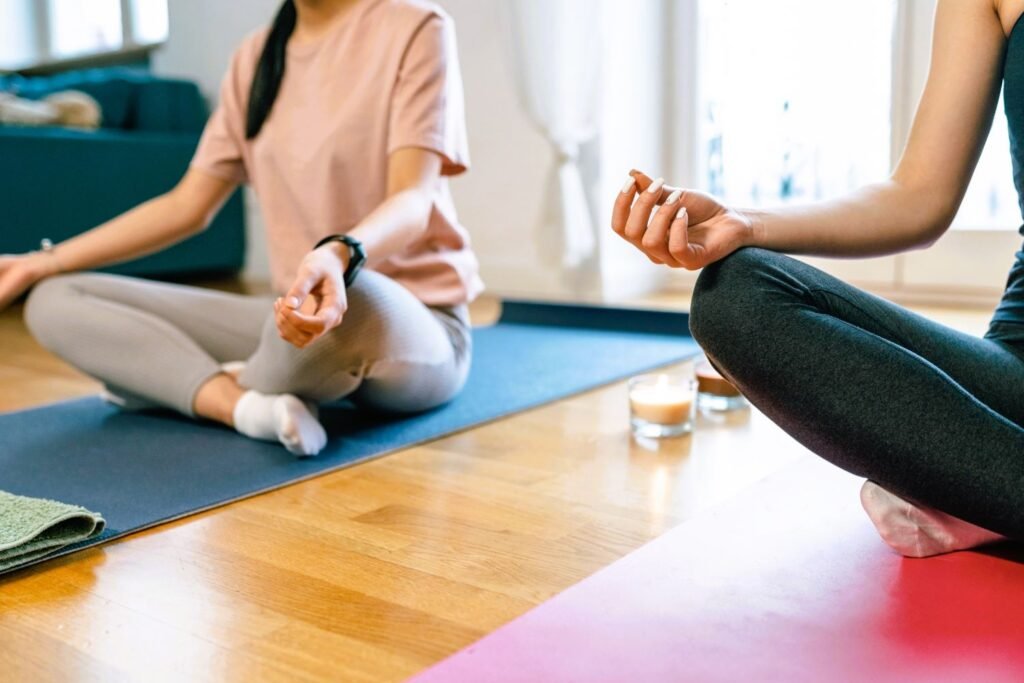
What Your Meditation Posture Says About Your Nervous System (It’s Not About Sitting Up Straight)
Correct meditation posture isn’t about sitting up straight. Here’s how to find a position your nervous system can actually settle into.
Table of Contents
- The Posture Police in Your Head
- What Posture Actually Does to Your Nervous System
- What This Isn’t
- Four Postures, Four Nervous System States
- The Harder Truth
- How to Find Your Actual Posture
- Closing: Your Spine Isn’t a Report Card
The Posture Police in Your Head
You sit down to meditate, and before you’ve even closed your eyes, some internal drill sergeant is already correcting you. Shoulders back. Chin level. Spine straight like a string is pulling you up from the crown of your head. You adjust, hold it for four seconds, and your lower back starts complaining like it’s filing a grievance. By minute three you’re not meditating. You’re doing an isometric hold while pretending to find inner peace.
If that’s your experience, I want to tell you something that took me embarrassingly long to learn: correct meditation posture was never really about the spine. It’s about your nervous system, and the spine-straightening instruction most of us were handed is, at best, an oversimplified proxy for something much more specific — and at worst, actively working against the exact calm you’re trying to reach.
By the end of this, you’ll understand what posture is actually doing to your nervous system during meditation, why the “sit up straight” rule works for some bodies and backfires for others, and how to find a position that supports regulation instead of performing discipline. No ramrod spine required.
What Posture Actually Does to Your Nervous System
Here’s the plain-language version. Your posture and your nervous system are in constant, two-way conversation — not a one-way instruction where your mind tells your body to sit up straight and the body just complies. A collapsed, curled-forward posture tends to signal low energy, withdrawal, sometimes a freeze response — the body’s version of making itself small. A rigid, braced, chest-out posture tends to signal effort, vigilance, sometimes low-grade fight-or-flight — the body’s version of standing guard. Neither of these is “wrong” on its own; they’re just information about where your system currently is.
This idea draws loosely on polyvagal theory, a framework — popularized by researcher Stephen Porges and widely used in somatic and trauma-informed therapy circles — that describes how your autonomic nervous system shifts between states of safety, mobilization (fight-or-flight), and shutdown (freeze), and how physical cues, including posture, both reflect and influence which state you’re in. It’s worth saying plainly: polyvagal theory is an influential clinical framework, not settled physics, and some of its specific mechanisms are still debated among researchers. But the core, practical insight — that posture and physiological state influence each other in both directions — holds up well enough to be genuinely useful here, regardless of exactly how the underlying wiring works.
Translate that into your meditation cushion: a forced, ramrod-straight spine, held with effort, can read to your nervous system less like “I am safe and alert” and more like “I am bracing for something.” You’re not settling. You’re standing guard while sitting down. Meanwhile, the collapsed slump plenty of us default to when we’re tired isn’t automatically “wrong” either — but it can tip toward low-energy withdrawal rather than the relaxed, engaged alertness meditation is usually going for. The goal was never maximum spinal extension. It’s a posture your actual nervous system reads as safe enough to stop bracing and start settling.
This reframe matters because most posture instruction gets the causality backwards. The common assumption is: fix the posture, and the calm follows — sit up straight, and stillness will arrive as a reward for good form. But for a lot of people it works the other way around. The nervous system state comes first, and the posture is downstream of it, not upstream. A wired, hypervigilant system will often brace regardless of how many times you’re told to relax your shoulders, because the bracing isn’t a postural habit — it’s a physiological state expressing itself through the body. Correct the state, or at least support it, and the posture tends to soften on its own. Try to correct the posture directly while ignoring the state underneath it, and you get exactly what a lot of frustrated meditators report: a spine that looks technically right and a body that feels anything but settled.
What This Isn’t
“This means posture doesn’t matter at all — slump however you want.” Not quite. Posture matters, genuinely — a totally collapsed position can tip you toward drowsiness or a foggy, checked-out state that isn’t the same as calm regulation. The point isn’t “posture is irrelevant.” It’s that rigid, effortful correctness isn’t the mechanism that makes posture useful. Ease and support are.
“There’s one correct posture and everyone should find their way to it.” This is the myth doing the most damage. Different bodies, different nervous system histories, different amounts of chronic tension all mean the “correct” posture is genuinely individual, not a single universal template with a lotus position at the center of it. A posture that helps one person settle can be the exact posture that keeps another person braced.
“If you’re uncomfortable, you just need to build tolerance and push through.” Sometimes true — mild, ordinary discomfort from sitting still is normal and does ease with practice. But there’s a real difference between “this is new and slightly uncomfortable” and “my body is actively bracing against pain the entire session,” and the second one isn’t a discipline problem to muscle through. It’s a signal that the position itself needs to change.
“Lying down or slouching means you’re not really meditating.” This one deserves a direct correction: plenty of legitimate meditation traditions and clinical protocols use lying-down or supported postures deliberately, especially for people with chronic pain, trauma histories, or physical limitations. A supported posture isn’t a lesser version of “real” meditation. It’s a valid entry point, full stop.
Four Postures, Four Nervous System States
Here’s the substantive middle — four common postures people fall into, and what each one tends to be doing underneath the surface. This isn’t a diagnosis; it’s a mirror. Notice which one sounds familiar.
- The Brace — spine locked, shoulders pulled back, chin lifted
This is the “textbook” posture most people were taught, and for some regulated nervous systems it genuinely works well — alert without strain. But for a lot of people, especially anyone carrying chronic tension or a history of needing to appear composed, this posture is held with real, if subtle, muscular effort the whole session. The tell: you finish meditating and your shoulders or jaw ache, or you notice you’ve been subtly holding your breath. That’s not stillness. That’s vigilance wearing stillness as a costume.
- The Collapse — chest caved, head forward, spine rounded
Often the default when you’re exhausted, depleted, or meditating at the end of a long day. This posture can tip your system toward drowsiness or a dissociative, checked-out fog rather than calm presence — you’re technically sitting still, but you’re not really there. If you consistently drift into sleep or blankness within a couple of minutes, the collapse might be part of why; there’s simply not enough structural support to stay gently alert.
- The Brace-and-Collapse — rigid through the chest, slumped through the low back
A surprisingly common hybrid: effortful, lifted posture up top, paired with a give-out in the lower back and hips, often because the person never built the postural support to actually hold the “correct” position and is faking the top half while the bottom half quietly surrenders. This one tends to produce the most physical discomfort of the four, because you’re paying the tension cost of bracing without getting the actual stability benefit.
- The Supported Settle — upright but resting on external support, weight distributed, no muscular effort required to stay there
This is the target state, and it looks different for almost everyone. For some people it’s sitting cross-legged with a cushion under the hips, tilting the pelvis just enough that the spine stacks naturally without effort. For others it’s a chair with feet flat and a low-back cushion. For others, especially anyone with chronic pain or significant nervous system dysregulation, it’s lying down with a pillow under the knees. The common thread isn’t the specific position — it’s that your skeleton and the support beneath you are doing the work, not your muscles. Your body isn’t performing alertness. It’s resting into a structure that happens to keep you upright enough to stay present.
A useful way to test which category you’re actually in: notice what happens in the first sixty seconds if you stop consciously monitoring your posture altogether. If you’re in a Supported Settle, very little changes — the position more or less holds itself, because it was never dependent on your attention in the first place. If you’re in a Brace, a Collapse, or the hybrid, something shifts almost immediately the moment you stop watching it — you slump further, you tense back up, you catch yourself readjusting. That shift is diagnostic. It tells you how much of your current posture was actually structural support, and how much was just effort you’d stopped noticing you were spending.
The Harder Truth
Here’s what most posture guides won’t tell you: for a lot of people, “just sit up straight” is not a neutral instruction. It’s a request that lands directly on old material.
If you grew up in a household where posture was policed — sit up straight, stop slouching, you look lazy — “correct” meditation posture can unconsciously reactivate that exact dynamic: an external authority evaluating your body and finding it insufficient. You sit down to meditate, and without realizing it, you’re performing posture for an imagined critical observer, the same way you might have at a childhood dinner table. That’s not relaxation. That’s compliance dressed up in spiritual language, and no amount of “just relax into it” advice touches the actual source of the tension, because the tension was never really about your spine.
There’s a physical version of this same trap too. A lot of adults are carrying genuine structural limitations — old injuries, scoliosis, chronic pain conditions, simply bodies that have never had the hip flexibility for a traditional cross-legged seat — and generic posture instructions weren’t written with those bodies in mind. Being told to “just sit up straight” when your actual anatomy makes that position genuinely painful isn’t a motivational nudge. It’s advice engineered for a different body than the one you have, delivered with enough confidence that you assume the failure is yours rather than the instruction’s.
Cultural and gendered layers show up here too, quietly, and rarely get named. Plenty of people — women in particular, though not exclusively — grew up receiving posture correction as a form of social discipline: sit like a lady, don’t slouch, take up less space. For someone carrying that history, “sit up straight” in a meditation context can unconsciously summon the entire weight of that earlier policing, and the resulting posture is less “alert presence” and more “compliance with an old, unspoken rule about how much room I’m allowed to take up.” That’s not a small psychological footnote. It can be the entire reason a technically correct posture still feels like anything but peace.
I’ll be honest about my own version of this. I spent years meditating in a posture I now recognize as pure bracing — spine locked, shoulders pinned back, because somewhere along the way I’d absorbed the idea that “good” meditators looked composed, even serene, from the outside. I wasn’t settling into anything. I was performing stillness while my actual nervous system stayed quietly on guard the entire session, bracing against an audience that was never in the room. It took a somatic therapist watching me sit — actually watching, not just asking how it felt — to point out that my jaw was clenched and my breath was shallow the whole time, and that no amount of “trying to relax” inside that posture was going to work, because the posture itself was the thing generating the tension I was trying to meditate away.
“I was performing stillness while my nervous system stayed quietly on guard the entire session, bracing against an audience that was never in the room.”
The harder truth underneath all of this: posture instruction, like a lot of wellness advice, often assumes a body and a history that isn’t universal — a body without chronic pain, a childhood without posture policing, a nervous system with a reasonably regulated baseline to begin with. When the instruction doesn’t fit, the industry’s default explanation is almost always “you’re not doing it right,” rarely “the instruction wasn’t built for you.” That framing puts the failure in exactly the wrong place, over and over, for a lot of people who were never actually the problem.
How to Find Your Actual Posture
Not a rulebook — a process for figuring out what your specific nervous system actually needs, because that’s the entire point of this reframe.
- Start seated, then ask what’s working without your help. Sit however feels most natural for a moment, then notice: which parts of this position are holding themselves up without effort, and which parts are you actively muscling into place? The parts you’re muscling are the parts worth adjusting.
- Add support before you add effort. If your spine wants to round, don’t correct it by tensing — add a cushion under your hips, tilting your pelvis forward until the spine has less work to do. If your neck wants to drop, check whether your head is genuinely too heavy for your current support, not whether you’re “slacking.”
- Do the jaw-and-shoulder check mid-session. Anxious or braced postures tend to show up first in the jaw, shoulders, and breath. Midway through a session, without changing anything on purpose, just notice: is my jaw tight? Are my shoulders near my ears? If yes, that’s data about the posture, not a personal failing to note and move past.
- Try lying down once, deliberately, without judgment. If you’ve never meditated lying down because it felt like “cheating,” try it once as an actual experiment. Notice whether your mind and body access a different, perhaps easier, quality of stillness there — and if it does, let that be useful information instead of evidence you’re doing meditation wrong.
- Let the posture change session to session. A posture that supported you on a calm Tuesday might not be right on an exhausted, wired Thursday. Checking in each time, rather than defaulting to the same “correct” position regardless of your state, treats posture as responsive rather than fixed.
- If chronic pain or a physical condition is part of this, work with a professional. A physical therapist or a trauma-informed somatic practitioner can help you find genuinely supportive positions specific to your body, rather than adapting generic instructions written for a body that isn’t yours.
- Give any new posture more than one session before judging it. A genuinely supportive position can still feel unfamiliar or even mildly wrong at first, simply because it’s different from what you’re used to holding. Give it three or four sessions before deciding whether the position itself isn’t working, versus you just noticing the absence of a bracing pattern you didn’t know you relied on.
Closing: Your Spine Isn’t a Report Card
Here’s the reframe worth carrying with you: your posture during meditation was never a test of your discipline, and a straight spine was never proof you were doing it “right.” It’s closer to a conversation — your nervous system telling you, in real time, what it needs in order to feel safe enough to actually settle. A braced spine isn’t moral failure. It’s information. A collapsed posture isn’t laziness. It’s information too. The question was never “am I sitting correctly.” It’s “what is my body telling me it needs right now, and am I willing to actually give it that instead of overriding it with an old rule I never chose.”
Next time you sit down to meditate and feel that internal drill sergeant reaching for your shoulders, try something different: ask your body what it’s actually bracing against, instead of correcting the bracing itself. You might be surprised how much of “good posture” was never really about your spine at all.
If you’ve spent years treating your body as something to correct rather than something to listen to, this one small shift — support instead of effort, curiosity instead of correction — tends to ripple further than the cushion you’re sitting on. It’s a small practice with an outsized return: the moment you stop grading your posture and start reading it, meditation itself usually gets a little easier to actually want to return to.
A short note: I’m not a physical therapist or a somatic practitioner — just someone who spent a long time confusing rigidity with peace. If you’re navigating chronic pain, a significant physical condition, or a trauma history that makes stillness itself difficult, please work with a qualified professional to find what’s actually right for your body rather than taking a generic template — including this one — as gospel.
Related Articles

Awakening
Spiritual Awakening Integration Guide
You Had a Spiritual Awakening. Now What? A 30-Day Integration Guide A spiritual awakening can change the way you
August 16, 2026
No Comments

Manifestation
Manifestation vs. Goal Setting: Are They Really Different?
Manifestation vs. Goal Setting: Are They Really Different? Manifestation vs. goal setting: where do they overlap, where do they differ, and can
September 5, 2026
No Comments

Awakening
Why Spiritual Awakening Can Feel Lonely
Why Spiritual Awakening Can Feel Lonely—even When Your Life Looks Fine There is a particular kind of loneliness that is
August 18, 2026
No Comments
Wisdom
Wu Wei Isn’t “Doing Nothing”: The Taoist Idea Modern Productivity Culture Keeps Misreading
Wu Wei Isn’t “Doing Nothing”: The Taoist Idea Modern Productivity Culture Keeps Misreading Discover the true wu wei meaning in
September 7, 2026
No Comments

Mysteries & Alternative Beliefs
Synchronicity or Just a Coincidence
Synchronicity or Just a Coincidence? How to Take Meaningful “Signs” Seriously Without Believing Everything Is a Message What does synchronicity
September 4, 2026
No Comments

Personal Transformation
You’re Not Lost. Your Old Life Just Doesn’t Fit Anymore: 11 Signs You’ve Outgrown Who You Used to Be
You’re Not Lost. Your Old Life Just Doesn’t Fit Anymore: 11 Signs You’ve Outgrown Who You Used to Be Feeling
September 12, 2026
No Comments