
The Yin-Yang Symbol Is More Radical Than “Balance”: What It Actually Represents
Discover the deeper yin yang meaning: not good versus evil, but a philosophy of polarity, interdependence, change, transformation, and timing.
Table of Contents
- The symbol everyone recognizes—and almost everyone simplifies
- What yin and yang originally meant
- Why “balance” is only part of the story
- A visual guide to the yin-yang symbol
- Why yin and yang are not good and evil
- Yin and yang are relationships, not permanent identities
- Why each side contains the other
- Transformation: the part most explanations leave out
- How yin and yang entered Chinese cosmology
- The Yijing and a universe made of change
- The familiar symbol came much later than the philosophy
- Yin and yang, masculine and feminine
- What happens when one pole reaches an extreme
- The harder truth about harmony
- How to apply yin-yang philosophy without turning it into a life hack
- A more useful way to think about “balance”
- Author’s note
You’ve Seen This Symbol a Thousand Times. But What Does It Actually Say?
You recognize it instantly.
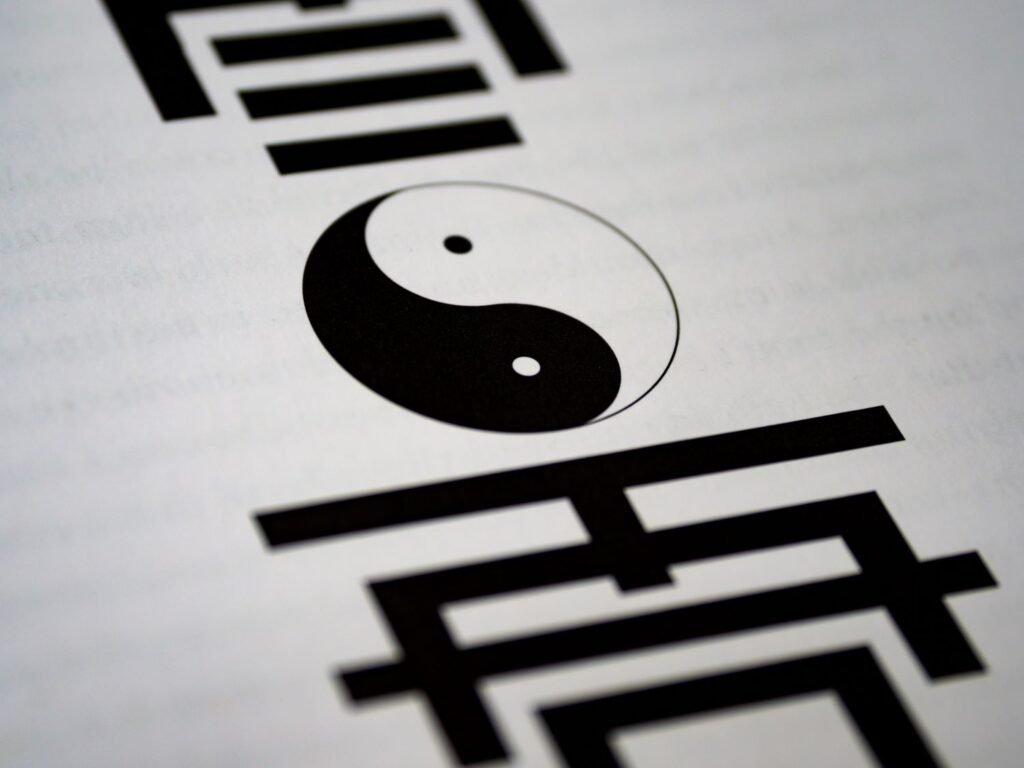
A circle divided into black and white. Two curved forms folding into each other. A white dot floating inside the black, a black dot inside the white.
Ask what it means and the answer usually arrives just as quickly:
“Balance. Good and bad. Opposites.”
Close.
And yet those three words flatten one of the most sophisticated ideas in Chinese philosophy into something resembling a motivational refrigerator magnet.
The deeper yin yang meaning is not simply that life contains two opposite things and we should keep them evenly balanced. Yin-yang thinking is concerned with something far more dynamic: how apparent opposites depend on one another, define one another, transform into one another, and participate in larger cycles of change.
Day becomes night.
Activity requires recovery.
Expansion eventually meets contraction.
What is strong in one context may be yielding in another.
And what appears to be the opposite of something may already be developing inside it.
Once you understand that, the famous black-and-white symbol stops looking like a diagram of perfect balance.
It starts looking like a picture of reality refusing to stand still.
What Did Yin and Yang Originally Mean?
Before yin and yang became cosmic principles, the words were remarkably concrete.
Early uses were connected to experiences of sunlight and shadow. Yang came to be associated with the sunny, bright side of a landscape; yin with the shaded, darker side. Early Chinese sources also associated them with everyday contrasts such as brightness and darkness, activity and rest. The terms appear in very early Chinese writing, long before the familiar black-and-white symbol existed.
Imagine a mountain.
One slope faces the sun.
The other lies in shadow.
Those are not two separate mountains.
They are two conditions of one landscape.
And more importantly, the conditions change.
As the sun moves, the relationship changes.
This simple image already contains much of what later yin-yang philosophy would develop.
Yin and yang are distinguishable, but they are not independent worlds.
They are contrasting aspects of an interconnected process.
That makes them different from the kind of dualism many Western readers instinctively project onto the symbol.
This is not God versus Satan.
Spirit versus matter.
Good versus evil.
Light defeating darkness.
It is closer to sunlight and shade belonging to the same terrain.
The distinction matters.
Because if you begin with enemies, your goal becomes victory.
If you begin with complementary conditions, your goal becomes understanding the relationship.
Why “Balance” Doesn’t Quite Capture It
Calling yin and yang “balance” is not exactly wrong.
It is simply incomplete.
The word balance often makes us imagine a scale:
50 percent yin.
50 percent yang.
Perfectly level.
Nothing moving.
Congratulations. Cosmic equilibrium achieved.
But nature almost never looks like that.
Summer is not half winter.
Noon is not half midnight.
Inhaling and exhaling do not occur simultaneously in equal measure.
A person sprinting toward a finish line does not need to maintain equal quantities of movement and stillness during every second of the race.
Yin-yang philosophy is much more interested in appropriate relationship, proportion, alternation, and timing than permanent numerical equality.
In classical Chinese cosmological thinking, yin and yang became major emblems for complementary forces whose conjunction generates phenomena and whose cyclical alternation helps structure the workings of the cosmos.
That last word matters:
alternation.
Reality breathes.
One tendency becomes prominent while another recedes.
Then conditions shift.
The question is not always:
“How do I make these equal?”
Sometimes the better question is:
“What does this moment require?”
That is a much more radical philosophy than balance.
A Visual Guide to the Yin-Yang Symbol
The familiar yin yang symbol is commonly called a taijitu—a “diagram of the Great Ultimate” or “Supreme Ultimate.”
Its visual simplicity hides a surprising amount of philosophical information.
Start with the circle.
The black and white forms are contained within one boundary. Whatever their differences, they belong to a larger whole.
Then notice the curved division.
It is not a straight line splitting reality into two sealed territories.
Each side seems to swell as the other diminishes.
Visually, the image suggests process rather than static opposition.
Then there are the two dots.
Black contains white.
White contains black.
The conventional interpretation is powerful: neither pole exists in absolute purity. Each contains the possibility, presence, or “seed” of its counterpart.
Finally, neither side can be visually removed without destroying the composition itself.
The image works because of relationship.
Modern explanations sometimes present every graphic detail as though a single ancient philosopher designed the familiar icon and assigned each curve an official meaning. History is less tidy. Yin-yang ideas are much older than the standardized symbol, while Chinese thinkers developed numerous cosmological diagrams over centuries. The tradition of taiji diagrams became especially important during the Song dynasty, and forms closer to today’s familiar swirling image developed later.
So the symbol is best understood as a visual condensation of a much older philosophical world, not the point where yin-yang philosophy began.
Is Yin Yang Really About Good and Evil?
No.
This may be the most persistent misconception.
Black looks sinister to many modern Western eyes.
White looks pure.
So the symbol is easily interpreted as:
evil contains some good,
good contains some evil,
and we need both.
That is not what yin-yang categories originally mean.
Neither yin nor yang is inherently morally superior.
The Internet Encyclopedia of Philosophy specifically notes that yin-yang thinking does not establish a value hierarchy in which one side is metaphysically superior to the other.
A dark bedroom at midnight is not evil.
Rest is not morally inferior to activity.
Winter has not failed because trees stop producing leaves.
Likewise, yang is not automatically virtuous.
Heat can nourish.
Too much heat can destroy.
Activity can create.
Unrelenting activity can exhaust.
Stillness can restore.
Excessive stillness can stagnate.
The useful question is not:
Which side is good?
It is:
What is this quality doing here, in this situation, at this intensity, at this time?
That moves us away from moral cartooning and toward something more ecological.
A thing can be appropriate in one relationship and destructive in another.
Yin and Yang Are Not Things. They Are Relationships.
This may be the most important idea in the entire article.
You are not simply “yin.”
Your partner is not simply “yang.”
Coffee is not eternally yang.
Water is not permanently yin in every possible context.
Chinese philosophical classifications are relational.
The Stanford Encyclopedia of Philosophy gives a useful example: yin can describe receptive or contracting tendencies while yang can describe expanding or more assertive tendencies, but these are not fixed essences. The same thing may function as yang relative to one thing and yin relative to another.
Think about temperature.
Warm water is yang compared with ice.
That same warm water is yin compared with boiling water.
Nothing about the water changed merely because you changed the comparison.
Its relationship changed.
Or consider a person.
You may be outspoken in your family and quiet in a meeting.
You may lead at work and follow when learning a new skill.
You may spend the morning producing and the evening receiving.
Trying to classify your entire identity as “a yin person” or “a yang person” misses something fundamental.
Yin-yang thinking is less interested in discovering which cosmic team you belong to.
It asks how qualities arise in relationship.
Yin and yang are not labels pasted onto reality. They are a way of seeing how reality behaves.
Why Does Each Side Contain the Other?
Those two dots may be the feature people remember most.
They also point toward an idea more unsettling than “everything has a little opposite inside.”
Consider success.
You work for years toward a promotion.
You finally receive it.
Inside the achievement is the beginning of something you did not have before: greater responsibility, vulnerability, expectations, perhaps less free time.
The victory contains the seed of a new difficulty.
Now consider failure.
A business collapses.
It hurts.
But inside the collapse may exist information unavailable while you were desperately trying to preserve the company.
Failure contains possibilities that success prevented you from seeing.
This does not mean every tragedy is secretly wonderful.
That kind of forced positivity would be a crude use of yin-yang thought.
It means conditions are rarely philosophically pure.
Rest can contain preparation for action.
Silence can contain communication.
Strength can contain vulnerability.
Beginnings already contain the conditions of endings.
Endings create conditions for beginnings.
The dot inside the opposite side is therefore not merely a decorative reminder to “look on the bright side.”
It challenges the fantasy of absolutes.
The Symbol Is About Transformation as Much as Complementarity
Here is where yin-yang philosophy becomes considerably more interesting than “opposites attract.”
Opposites do not merely sit beside one another.
They change into one another.
Night becomes morning.
Cold gives way to warmth.
Tension reaches a point at which release becomes possible.
An inhalation fills the lungs until exhalation must begin.
A civilization expands until the conditions created by expansion produce different pressures.
The Stanford Encyclopedia describes early Chinese cosmological thinking as fundamentally process-oriented: things are interconnected, constantly changing, and frequently understood through cyclical patterns produced by polar forces such as yin and yang.
This means the symbol is not merely showing two halves.
It is showing a relationship in motion.
Imagine freezing the year on July 21 and declaring:
“Summer has won.”
Give it time.
Yang does not defeat yin forever.
The very fullness of one phase participates in the emergence of the next.
There is a warning hidden in this.
Do not confuse temporary dominance with permanent reality.
And do not assume that because something is currently weak, quiet, hidden, or incomplete, it has no role in what comes next.
What Happens When One Pole Reaches an Extreme?
Chinese cosmological thought frequently pays attention to reversals.
Growth reaches maturity.
Maturity moves toward decline.
Contraction eventually creates conditions for expansion.
This is not a magical law guaranteeing that every bad week is followed immediately by a good one.
It is a way of noticing that processes contain limits.
Take productivity.
You can increase output by working longer.
For a while.
Then additional hours reduce concentration.
Errors rise.
Creativity declines.
The strategy that created progress eventually begins producing the opposite result.
More effort becomes less effective.
Or consider protection.
A parent protects a child because care requires protection.
But protection taken far enough becomes control.
Control prevents the child from developing competence.
The attempt to create safety can eventually create fragility.
The useful yin-yang question is:
At what point does a quality begin transforming into its opposite?
Confidence becomes arrogance.
Caution becomes paralysis.
Generosity becomes self-erasure.
Independence becomes isolation.
Discipline becomes rigidity.
Openness becomes lack of boundaries.
The philosophy does not tell you that any one quality is wrong.
It asks you to become sensitive to degree, context, and change.
The Yijing: A World Built Around Change
You cannot fully understand yin-yang philosophy without encountering the intellectual world of the Yijing, or Book of Changes.
Its system uses broken and unbroken lines that later came to be associated with yin and yang.
These lines combine into trigrams and hexagrams—patterns used to represent situations and processes of change. In the mature interpretive tradition, eight trigrams and sixty-four hexagrams provide a sophisticated symbolic vocabulary for shifting configurations rather than static things.
Even its English title tells you where the emphasis lies.
Changes.
Not:
The Book of Permanently Stable Personalities.
The world is being understood through configurations.
A moment has a shape.
But the shape contains movement.
This is very different from the desire to divide existence into permanent boxes.
Healthy/unhealthy.
Winner/loser.
Strong/weak.
Beginning/end.
Yin-yang thinking continually asks what a condition is becoming.
That may explain why the philosophy still feels surprisingly modern.
Many of our biggest mistakes happen because we assume today’s conditions are identities.
“I am successful.”
“I am broken.”
“This relationship is good.”
“My career is failing.”
Maybe.
But what process are you inside?
What is increasing?
What is decreasing?
What is emerging that today’s label cannot yet describe?
The Philosophy Is Older Than the Symbol
This is another piece of history worth getting right.
Yin and yang are ancient concepts.
The familiar ☯ image is not nearly as ancient in its present form.
Early forms of yin and yang language appear many centuries BCE, and yin-yang systems became increasingly important in Chinese cosmology during the late Zhou and Han periods. The well-known circular diagrams, however, belong to a much later visual history. The Song dynasty produced important taiji diagrams; subsequent thinkers continued developing them, and forms approaching the now-iconic interlocking black-and-white design emerged later still.
This matters for the same reason historical accuracy always matters.
The symbol did not fall from the sky complete.
It is part of a long intellectual tradition in which ideas were interpreted visually, philosophically, medically, religiously, and cosmologically.
That makes it more interesting, not less.
The yin-yang symbol is not merely ancient clip art.
It is the visible surface of centuries of thinking about how change works.
Yin and Yang Aren’t Just “Masculine and Feminine Energy”
This is where modern spirituality often becomes careless.
Yin eventually became correlated with qualities including receptive, dark, cool, inward, and feminine; yang with active, bright, warm, outward, and masculine qualities. Chinese cosmological systems developed extensive webs of such correspondences.
But there is a huge difference between saying:
masculine and feminine became yin-yang correlations
and saying:
women are essentially yin and men are essentially yang.
The latter turns a relational cosmology into a personality prison.
Remember: the categories are contextual.
A woman can behave in ways categorized as yang.
A man can occupy a yin role within a particular relationship.
The same person moves through receptive and assertive, quiet and active, contracting and expanding modes constantly.
There is also a historical reality worth acknowledging: yin-yang correlations have sometimes been used within hierarchical gender systems.
Ancient philosophy is not automatically immune to the inequalities of the societies interpreting it.
Respecting a tradition does not require pretending every historical application was timeless wisdom.
If anything, the relational character of yin and yang gives us reason to resist simplistic gender essentialism.
A philosophy of transformation should not become a method for freezing people into roles.
Harmony Is Not the Same Thing as Peacefulness
This is the harder truth modern wellness culture often avoids.
“Harmony” sounds pleasant.
Incense.
Soft music.
Nobody raising their voice.
But functioning systems are not necessarily quiet systems.
Your immune system achieves health partly by attacking threats.
Muscles grow through stress followed by recovery.
Honest relationships sometimes require conflict.
A boundary may temporarily create less peace while restoring a healthier relationship.
Yin-yang harmony is not simply the absence of tension.
Difference is built into it.
Polarity is built into it.
The question is whether those differences participate in a viable whole.
This matters because “balance” can become spiritually dangerous when it is used to neutralize legitimate judgment.
Someone harms you.
You do not need to respond:
“Well, there’s yin and yang in everything.”
A corrupt system is not made ethical because opposites exist.
An abusive relationship does not need “more balance.”
Sometimes the appropriate response is unmistakably decisive.
Yin-yang philosophy is descriptive of relational processes.
It is not a command to tolerate whatever happens.
Harmony does not require eliminating difference. But neither does it require making peace with harm.
That distinction prevents ancient symbolism from becoming modern spiritual bypassing.
A Personal Lesson in Trying to “Balance” Everything
There is a particular self-improvement trap I find easy to recognize.
You decide your life should be balanced.
So you create categories.
Work.
Relationships.
Exercise.
Rest.
Creativity.
Spiritual practice.
Every category should receive proper attention.
This sounds healthy until you attempt to make every week look like a perfectly divided pie chart.
Then real life arrives.
One week, a project genuinely needs more of you.
Another week, your body needs recovery.
Someone you love becomes ill.
A creative opportunity appears.
You enter a period of intense learning.
You become a parent.
You grieve.
The perfect pie chart is destroyed by Tuesday.
Yin-yang thinking offers a more humane alternative.
Balance may exist across movement, not inside every moment.
There are seasons of expansion.
Seasons of contraction.
Moments for assertion.
Moments for listening.
Periods of production.
Periods where apparently “nothing” is happening but the next phase is being prepared.
A healthy life may look unbalanced in a photograph.
You have to watch the film.
How Do You Actually Apply Yin-Yang Philosophy?
You do not need to start classifying your refrigerator contents as yin or yang.
Begin with situations where you feel stuck.
Then ask questions that reveal relationships rather than fixed judgments.
What quality has become excessive?
Maybe your problem is not lack of discipline.
Maybe discipline has become rigidity.
Maybe your openness to possibilities has become chronic indecision.
Maybe rest has turned into avoidance.
Maybe ambition has become inability to experience enough.
Do not automatically attack the quality.
Ask whether its degree has changed its function.
What is missing because its opposite has been excluded?
If your team is permanently brainstorming, perhaps it needs decision.
If everybody is making decisions, perhaps nobody is listening.
If your relationship contains constant harmony because neither person expresses disagreement, the missing ingredient may not be more peace.
It may be conflict.
If your life is intensely structured, spontaneity may restore something.
If your life is chaos, another spontaneous adventure may not be the medicine.
Context.
Always context.
Ask: What Phase Am I Actually In?
This may be one of the most useful practical questions hidden inside the philosophy.
We often suffer because we demand harvest during planting.
You launch a business and immediately judge it by mature-company standards.
You begin meditating and become frustrated that your mind still wanders.
You enter grief and ask why you are not “moving on.”
You start learning something and interpret incompetence as proof that you lack talent.
Yin-yang thinking places individual moments inside processes.
A seed is not a failed tree.
Night is not defective daylight.
The beginning of a cycle does not have the qualities of its culmination.
Ask:
What phase is this?
Then:
What does this phase require?
Patience?
Action?
Gathering?
Releasing?
Visibility?
Withdrawal?
Learning?
Decision?
The answer may change how you interpret the very same experience.
Look for the Opposite Already Forming
When things are going well, this practice keeps you awake.
What vulnerability is success creating?
What dependency is convenience creating?
What maintenance will growth require?
What have you stopped noticing because the current system works?
When things are going badly, the same question prevents hopelessness.
What information is failure producing?
What possibility does the ending make available?
What skill is difficulty forcing you to develop?
What assumption can no longer survive?
Again, this is not compulsory optimism.
Some events are simply devastating.
The point is not to pretend darkness is secretly light.
It is to remember that no condition contains the whole future.
The black contains a white point.
The white contains black.
Conditions carry possibilities beyond their present appearance.
Stop Asking Which Side You Are
Modern personality culture loves identities.
Introvert.
Extrovert.
Empath.
Leader.
Masculine.
Feminine.
Type A.
Old soul.
Yin-yang philosophy can be distorted into one more sorting machine:
“Take this quiz to discover whether you’re 73% yin.”
Resist the temptation.
A more philosophically interesting question is:
Where am I yin, where am I yang, and relative to what?
You may be highly receptive in art and intensely assertive in business.
You may be quiet around strangers and dominating around family.
You may need more stillness intellectually and more action physically.
The categories become useful when they illuminate movement.
They become restrictive when they become identities.
You are not one half of the symbol searching for someone to complete the circle.
You already contain relationships between both tendencies.
What Does Yin-Yang Mean for Relationships?
It does not mean finding your “opposite.”
Sometimes opposites complement each other.
Sometimes opposites spend twelve years arguing about the thermostat.
A more useful application is noticing how relational patterns co-create each other.
One person pursues.
The other withdraws.
The more one pursues, the more the other withdraws.
The more the other withdraws, the more urgently the first pursues.
Who caused the problem?
That question may be less useful than seeing the cycle.
Each behavior becomes part of the condition producing its counterpart.
Once the pattern is visible, either person changing their participation can affect the whole.
This is a profoundly yin-yang way of looking at life.
Not isolated objects.
Relationships.
Feedback.
Mutual conditioning.
Transformation.
The question shifts from:
“Which person is the problem?”
to:
“What process are we creating together?”
That does not erase accountability.
It expands the field of vision.
What Does Yin-Yang Mean for Work and Ambition?
It means recognizing that relentless expansion is not a law of nature.
Businesses cannot grow infinitely without changing.
Bodies cannot perform infinitely without recovery.
Attention cannot remain outward forever.
A culture obsessed with “more” tends to interpret contraction as failure.
But contraction can consolidate.
Rest can integrate.
Saying no can preserve resources.
Ending one project can create the conditions for another.
This does not mean every contraction is wise.
A company losing customers may indeed have a serious problem.
Yin-yang philosophy is not a substitute for analysis.
It is a challenge to the assumption that only one direction counts as progress.
Sometimes growing is progress.
Sometimes simplifying is progress.
Sometimes speaking is progress.
Sometimes silence prevents damage.
Wisdom lies partly in distinguishing the moment.
Balance Is Not a Destination
Perhaps this is where the familiar explanation gets things most wrong.
We speak about “finding balance” as though balance were a hidden location.
You finally discover it.
Your calendar works.
Your relationships behave.
Your emotional state stabilizes.
Nothing unexpected happens.
You have arrived.
Reality has other plans.
The yin-yang symbol does not show a world where movement has stopped.
It shows a world whose coherence depends upon movement.
Health is continuously regulated.
Relationships are continuously negotiated.
Bodies age.
Cultures change.
Attention shifts.
Circumstances evolve.
What worked last year may become exactly the thing you need to release this year.
This means balance is less like standing perfectly still on solid ground.
It is more like walking.
Every step is technically a controlled fall.
Balance survives through continuous adjustment.
The Radical Message Hidden Inside a Familiar Symbol
Once stripped of pop-culture shorthand, the yin yang symbol meaning becomes much harder to reduce to “good and bad in balance.”
It says something stranger.
Opposites are not always enemies.
Difference can create relationship rather than war.
What looks separate may belong to a larger whole.
Qualities do not exist independently of context.
Nothing remains at maximum intensity forever.
One condition can generate another.
Every phase contains limits.
Every identity exists inside change.
And harmony does not mean freezing the universe at its most comfortable setting.
Perhaps that is why the symbol has survived so powerfully.
It gives us a way to imagine reality without demanding that reality become simple.
Black does not need to eliminate white.
White does not need to purify itself of black.
Neither side exists alone.
And neither remains exactly what it was.
The circle holds difference without pretending difference disappears.
That is far more interesting than balance.
It is a philosophy of relationship without sameness, polarity without permanent separation, and change without complete chaos.
And for anyone living through a season in which life refuses to remain neatly categorized, that may be the part worth remembering.
You do not always need to ask:
How do I get everything back into balance?
Sometimes ask:
What is changing?
What is becoming excessive?
What is trying to emerge?
What have I excluded?
What does this moment require from me now?
Those questions bring the symbol back to life.
Not as decoration.
Not as a personality test.
Not as shorthand for “good vibes.”
But as an invitation to look at the world differently.
Not as a collection of fixed things.
As relationships in motion.
Author’s Note
The philosophy of yin and yang is much broader than any single article, and it has developed across centuries of Chinese cosmology, philosophy, medicine, divination, Daoist practice, Confucian thought, and other intellectual traditions. The familiar taijitu is therefore best treated as an entry point rather than a complete map.
What makes the idea compelling is not that it provides a mystical formula for every problem. It is that it trains a different kind of attention.
Instead of asking only what something is, yin-yang thinking encourages us to ask what it is relative to, what it is becoming, what it depends upon, what it produces, and when its current tendency might reverse.
That is a more demanding way of seeing.
And perhaps a more realistic one.
Related Articles

Wisdom
7 Hermetic Principles
The “7 Hermetic Principles” Aren’t Ancient Egyptian Teachings: The History Most Spiritual Websites Leave Out The 7 Hermetic principles aren’t
August 31, 2026
No Comments

Mysteries & Alternative Beliefs
Why Some Coincidences Feel Deeply Meaningful
Why Some Coincidences Feel Deeply Meaningful Why do some coincidences feel deeply meaningful? Explore synchronicity, pattern recognition, probability, intuition, and
August 29, 2026
No Comments

WellBeing
The Healing Power of Doing Less: What Happens When You Stop Treating Every Moment as a Chance to Improve
The Healing Power of Doing Less: What Happens When You Stop Treating Every Moment as a Chance to Improve Slow
September 10, 2026
No Comments

Meditation
What Meditation Changes in the Brain
What Meditation Changes in the Brain—and What It Doesn’t Prove What does meditation do to the brain? Explore what
August 31, 2026
No Comments

Mysteries & Alternative Beliefs
Did You Sense Something Before It Happened?
Did You Sense Something Before It Happened? Why “Premonitions” Are So Difficult to Explain—and Even Harder to Test Premonitions can
August 26, 2026
No Comments

Consciousness
Is the Self Something the Brain Constructs?
Is the Self Something the Brain Constructs? What Neuroscience Says About the “You” Behind Your Thoughts Is the self-something the
August 31, 2026
No Comments