

Awakening
How to Bring Spiritual Practice Into Everyday Life
How to Bring Spiritual Practice Into Everyday Life How to carry spiritual practice into listening, conflict, work, driving, eating, decisions,
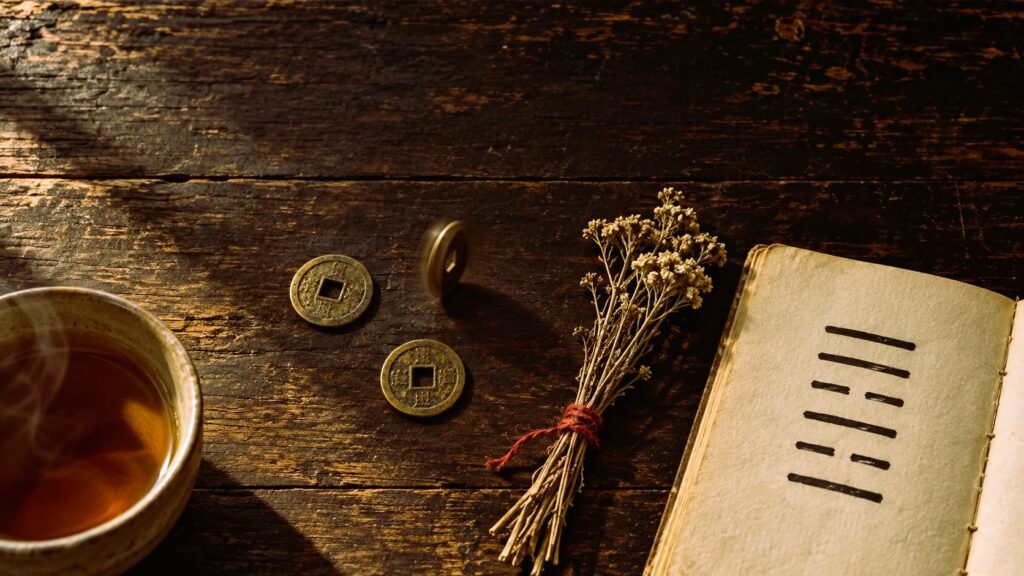
What is the I Ching? Beyond fortune-telling: a beginner’s guide to its history, how hexagrams
It’s late. You have a decision sitting on your chest: the job offer, the relationship that has gone quiet, the move you keep almost making. You’ve read the pros-and-cons lists. You’ve asked three friends and gotten four opinions. And somewhere in the search history between “should I quit my job” and “how to know if it’s the right time,” you typed: what is the I Ching?
Maybe you’d heard it was an ancient Chinese oracle. Toss some coins, get an answer. Part of you hoped that was true. Part of you was embarrassed to hope it.
Here’s the twist. You came looking for a fortune. What you’ll find is closer to a three-thousand-year-old conversation about one of the hardest skills a human can learn: knowing what this moment is, and how to act well inside it.
By the end of this guide you’ll know where the I Ching came from and why it outlived empires. You’ll understand how hexagrams are built and read, without needing any Chinese. You’ll be able to run your first consultation tonight. And you’ll know why the people who studied this book most seriously often cared least about predicting the future.
The I Ching (also spelled Yijing, and pronounced roughly “ee jing”) means the Classic of Changes. Yi is change. Jing is a classic, a canonical text, literally the warp thread that holds a weave together.
At its simplest, the I Ching is a book of 64 symbols called hexagrams. Each one is a stack of six lines, every line either solid or broken. Each hexagram has a name, a short judgment, and a brief comment on each of its six lines. You generate a hexagram through a chance procedure, then read the text attached to it.
That’s the mechanism. But the I Ching meaning goes much deeper than the mechanism, because for most of its history the book was read in two ways at once.
It was a divination manual: a tool for asking about harvests, marriages, military campaigns, illness.
And it was a philosophical classic: a map of how situations arise, ripen, peak and turn into their opposites, and of how a thoughtful person should conduct themselves at each stage.
An old Han-dynasty scholar named Zheng Xuan said the word yi carried three meanings at once. It meant change, because everything is in motion. It meant ease, because the underlying patterns are simple. And, paradoxically, it meant the unchanging, because the way things change follows a constant order. Hold those three together and you’re already reading the I Ching better than most horoscope apps do.
The I Ching isn’t one book from one author. It’s more like an old house where every generation added a room.
The oldest layer: the bones. Before the I Ching, Shang-dynasty diviners (roughly 1600 to 1046 BCE) asked questions by heating ox shoulder blades and turtle shells until they cracked, then reading the cracks. Thousands of these “oracle bones” survive, many inscribed with the questions: Will it rain? Will the king’s toothache heal? Will the hunt succeed?
The core text: the Zhouyi. Sometime during the Western Zhou dynasty (traditionally dated 1046 to 771 BCE), diviners shifted to sorting stalks of the yarrow plant. Their manual became the Zhouyi, the “Changes of Zhou.” This is the original heart of the book: 64 hexagrams, their names, judgments and line statements. The language is terse and strange. Dragons appear in fields. Foxes get their tails wet crossing streams. Someone is “treading on a tiger’s tail.” These are fragments of omen lore, proverb and ritual memory from a world we can only partly reconstruct.
The commentaries: the Ten Wings. Over the following centuries, most likely in the Warring States and early Han periods, scholars wrote a set of commentaries called the Ten Wings. Tradition credited them to Confucius. Modern scholars doubt that, but the attribution tells you something: the commentaries pulled a diviner’s handbook into the orbit of ethics and cosmology. The Great Commentary (Xici) in particular reads like a philosophy of the universe, built around the alternation of yin and yang.
The canon. In the second century BCE, under Emperor Wu of Han, the I Ching was installed among the Five Classics, the core curriculum of Chinese learning for roughly two thousand years. Officials studied it. Poets quoted it. Strategists, physicians and painters borrowed its vocabulary.
The great readers. Later thinkers kept rebuilding the house. Wang Bi, a brilliant philosopher who died at 23 in 249 CE, argued that the images were only a means to grasp meaning, and that once you’d grasped the meaning you could forget the images. Centuries later, the Neo-Confucian Zhu Xi insisted readers remember the book began as divination, while still treating it as a guide to moral self-cultivation.
Archaeology keeps adding surprises. A silk manuscript of the I Ching found in a tomb at Mawangdui, sealed in 168 BCE, arranges the hexagrams in a different order than the received text. It also includes discussions in which Confucius explains that he consults the book for its moral teaching, not only for its omens.
The West arrived late. Jesuit missionaries carried the I Ching to Europe, and around 1703 the mathematician Leibniz was startled to see binary arithmetic in one arrangement of the hexagrams. In 1950, Carl Jung wrote a foreword to Richard Wilhelm’s translation, framing it through his idea of synchronicity. That edition shaped how most English speakers still meet the book.
It’s not a crystal ball. The I Ching rarely tells you what will happen. It tells you what kind of situation you’re in and what tends to go well or badly in situations like it. Its favorite verdicts are conditional: perseverance furthers, no blame, regret vanishes, misfortune if you push ahead. Those are statements about conduct and consequence, not prophecy. Ask it “Will I get the job?” and you’re likely to get something closer to “Here is how a person behaves wisely when they are waiting to be chosen.”
It’s not a Chinese horoscope. The Chinese zodiac (Year of the Dragon and so on) belongs to a separate calendrical system. Feng shui is a related but distinct practice of spatial arrangement. Both borrow I Ching symbols, especially the eight trigrams you’ll see on talismans and compasses. Neither is the I Ching itself.
It’s not a fixed, ancient revelation that came down intact. It’s a layered text that people argued about for millennia. Even the hexagram order, the line readings and the meaning of key words were disputed. A reader who asks “What does hexagram 23 really mean?” is joining a debate, not looking up a definition.
It’s not only for believers. You don’t need to think the coins are guided by spirits for the I Ching to be useful. Confucian scholars, Daoist adepts, Buddhist monks, Jesuit missionaries, psychoanalysts and skeptical philosophers have all found something in it. Each of them brought different assumptions about why it works. That range is part of the point.
Start with two kinds of line.
A solid line (⚊) is yang: firm, active, initiating, outward-moving. A broken line (⚋) is yin: yielding, receptive, consolidating, inward-moving. Neither is good or bad. A day needs both noon and midnight. A conversation needs both speaking and listening.
Stack three lines and you get a trigram. There are exactly eight possible combinations, and each became associated with a natural image and a quality.
Trigram | Name | Image | Quality |
☰ | Qian | Heaven | Strong, creative, persistent |
☷ | Kun | Earth | Receptive, supportive, yielding |
☳ | Zhen | Thunder | Arousing, shock, sudden start |
☵ | Kan | Water | Danger, depth, flowing through |
☶ | Gen | Mountain | Stillness, stopping, boundaries |
☴ | Xun | Wind / Wood | Gentle, penetrating, gradual |
☲ | Li | Fire | Clarity, attachment, illumination |
☱ | Dui | Lake | Joy, openness, exchange |
Stack two trigrams and you get a hexagram: six lines, 64 possible combinations. Lines are always counted from the bottom up, the way a plant grows.
Here’s where it gets interesting. Look at hexagram 11, Tai (Peace) ䷊: Earth sits on top, Heaven below. Upside down, you’d think. But the commentaries read it as harmony. Heaven’s energy naturally rises; earth’s naturally sinks. Placed this way, they move toward each other and meet.
Now flip it. Hexagram 12, Pi (Standstill) ䷋, puts Heaven on top and Earth below, the “correct” order. And it means stagnation, because the two are moving apart. Nothing connects.
That single pair teaches more about I Ching thinking than any definition. Appearances can deceive. What matters is relationship and direction of movement, not whether things are in their “proper” places.
Each hexagram comes with three main kinds of text.
The six positions have rough personalities. The bottom line is a beginning, often hidden. The second is central and cooperative. The third sits at a risky threshold between the lower and upper halves. The fourth is close to power and must be careful. The fifth is the central place of leadership. The top line is the end of the story, sometimes wise, often overextended.
Hexagram 1, Qian (The Creative), shows this beautifully through one recurring image: a dragon.
On the first line, the dragon is hidden underwater: don’t act yet. On the second, it appears in the field: it’s time to show yourself and find allies. On the third, the exemplary person works hard all day and stays watchful at night. On the fourth, the dragon leaps but can still drop back into the depths. On the fifth, it flies in the heavens: full expression. And on the sixth, an overreaching dragon will have regrets.
Read those six lines once and you’ll never forget them. They aren’t predictions. They’re a portrait of timing, the arc of any ambition, from first quiet stirring to the moment just past the peak when the smart thing is to stop.
The goal of any method is the same: generate six lines, one at a time, from the bottom up, and note which of them are “moving.”
The yarrow-stalk method is the classical one. You start with 50 stalks, set one aside, and divide and count the remaining 49 through a slow, repeated sequence. It takes 15 to 30 minutes. That slowness was arguably the point: it turns asking into a ritual of attention.
The three-coin method became popular later because it’s fast. Here’s how it works:
A moving line is a line at its extreme, about to flip into its opposite. Old yang turns to yin; old yin turns to yang. If you get any moving lines, you read their line statements, which are the most specific part of the answer. Then you flip them to produce a second hexagram, which suggests where the situation is heading.
One quiet detail rewards curious readers. The coin and yarrow methods don’t produce the same odds. With coins, a moving yang and a moving yin line are equally likely (1 in 8 each). With yarrow stalks, moving yang is three times as likely as moving yin (3 in 16 versus 1 in 16). Traditionalists argue the asymmetry matters: yang changes readily, yin holds steady. It’s a small reminder that the method is part of the meaning.
I’ll tell you how this landed for me.
A few years ago, I was sitting on a resignation letter. Stable job, slowly suffocating. I’d convinced myself the only question was courage: jump or don’t. I tossed the coins half-ironically and got hexagram 5, Xu (Waiting).
My first reaction was irritation. Of course the cosmic answer was “do nothing.” But that isn’t what the text says. The judgment pairs waiting with sincerity and steadiness, and then, surprisingly, says it is favorable to cross the great river. My moving line, the first, described waiting out on the outskirts, far from danger, and staying constant.
It reframed the whole question. Not whether to go, but how to wait well before going. I spent the next five months building savings and quietly lining up clients. When I did leave, it wasn’t a leap. It was a crossing I’d prepared for.
Did the coins know something? I can’t tell you that. What I can tell you is that the text gave me a category I hadn’t considered: waiting as an active, intelligent posture, not a failure of nerve.
That’s the I Ching’s obsession. It treats time not as a neutral container but as something with texture. There are moments to begin and moments to retreat, moments to gather allies and moments to stand alone. The right action at the wrong time is the wrong action. Most of us were taught to ask what to do. The I Ching asks when, and in what spirit.
Most I Ching content stops at “ancient wisdom, toss some coins, be enlightened.” Here’s what it tends to leave out.
We don’t fully know what the original text meant. The Zhouyi was written in archaic Chinese, and many of its words had shifted meaning by the time the commentaries were written. Take the famous four-character formula that opens hexagram 1, yuan heng li zhen. Wilhelm’s tradition renders it as something like sublime success, furthered by perseverance. Several modern scholars argue it originally read closer to “a grand offering; favorable to divine.” Same characters, very different worldview. Every translation you hold is an interpretation, and the lofty, philosophical I Ching is partly the creation of later readers. That doesn’t make it fake. It makes it a living text, which is more interesting.
There’s no evidence the coins “know” anything. Honest practitioners don’t need you to believe that a toss of three coins is guided by cosmic intelligence. Statistically, your hexagram is chance. Whatever value a reading has comes from what happens next: the text interrupts your habitual thinking, offers an unfamiliar frame, and forces you to articulate how it applies. That’s real. It’s also not supernatural.
Ambiguity cuts both ways. The same openness that makes the I Ching thought-provoking makes it easy to hear only what you already wanted to hear. If every reading somehow confirms your plan, you’re not consulting the book. You’re consulting your preferences with extra steps.
The tradition itself warned about leaning on divination. The philosopher Xunzi, writing in the third century BCE, said that those who are good at the Changes do not divine. In the Analects, Confucius quotes a line from hexagram 32 about the disgrace that follows inconstancy, then remarks that people simply don’t need a reading to know that. The deepest readers wanted to absorb the book’s way of seeing so thoroughly that they no longer needed to cast it.
It belongs to a living culture. The I Ching isn’t a blank aesthetic for tote bags. It has a commentary tradition that is still studied in China, Korea, Japan and Vietnam. Approaching it with curiosity about that context, rather than as an exotic prop, isn’t just polite. It produces better readings.
Pull quote: The deepest readers wanted to absorb the book’s way of seeing so thoroughly that they no longer needed to cast it.
You can do this tonight with three coins, a notebook and twenty minutes.
A few common beginner traps to skip:
Here’s my favorite fact about the I Ching.
Hexagram 63 is called Jiji, After Completion. Every line sits in its “correct” place. On paper, it’s perfect order. And the text is uneasy about it: good fortune at the start, disorder at the end. Perfection, it suggests, is the moment things begin to slip.
So the book doesn’t end there. It ends on hexagram 64, Weiji, Before Completion. The image is a young fox that has almost crossed a frozen river and gets its tail wet at the last moment. Nothing is finished. Everything is still in motion.
A book about change that ends on not yet. That’s the I Ching in a single gesture.
You came here asking what the I Ching is. Maybe the better answer is that it’s a long, patient training in a question we’re rarely taught to ask: What time is it, really, in my life right now, and what does this moment ask of me? Not what will happen. What kind of person you’ll be while it does.
The coins are optional. The question isn’t.
If this opened something up for you, explore more pieces in our Ancient Wisdom section, where we look at contemplative traditions on their own terms, without the clickbait. And if you try your first reading this week, keep the notebook. You may be surprised by what it tells you in six months.
I came to the I Ching the way many people do: skeptical, a little desperate, and hoping for a shortcut. What kept me there wasn’t the feeling of being told the future. It was the experience of being handed an unfamiliar lens at exactly the moment my own had fogged over. I still don’t know why it works when it works. I’ve made peace with that. The book has survived three thousand years of people not knowing, and arguing about it, and coming back anyway. That seems like good company to keep.
Note: translations of I Ching passages in this article are paraphrased from the classical Chinese and from multiple English editions.
How to Bring Spiritual Practice Into Everyday Life How to carry spiritual practice into listening, conflict, work, driving, eating, decisions,

Manifestation vs. Goal Setting: Are They Really Different? Manifestation vs. goal setting: where do they overlap, where do they differ, and can

Stoicism vs. Buddhism: Two Ancient Paths Through Suffering That Are Not Saying the Same Thing Stoicism vs Buddhism: compare two ancient

The Ankh, Eye of Horus and Scarab: What Ancient Egyptian Symbols Actually Meant Egyptian symbols and meanings, decoded: what the

Guided vs. Silent Meditation: Which One Is Secretly Holding You Back? Guided meditation can help you start—but can it also hold

How to Build a Spiritual Practice You’ll Actually Keep A practical guide to building a spiritual practice that lasts, using