

Personal Transformation
How to Find Your Purpose in Life When You Have No Idea What You Want
How to Find Your Purpose in Life When You Have No Idea What You Want Learn how to find your
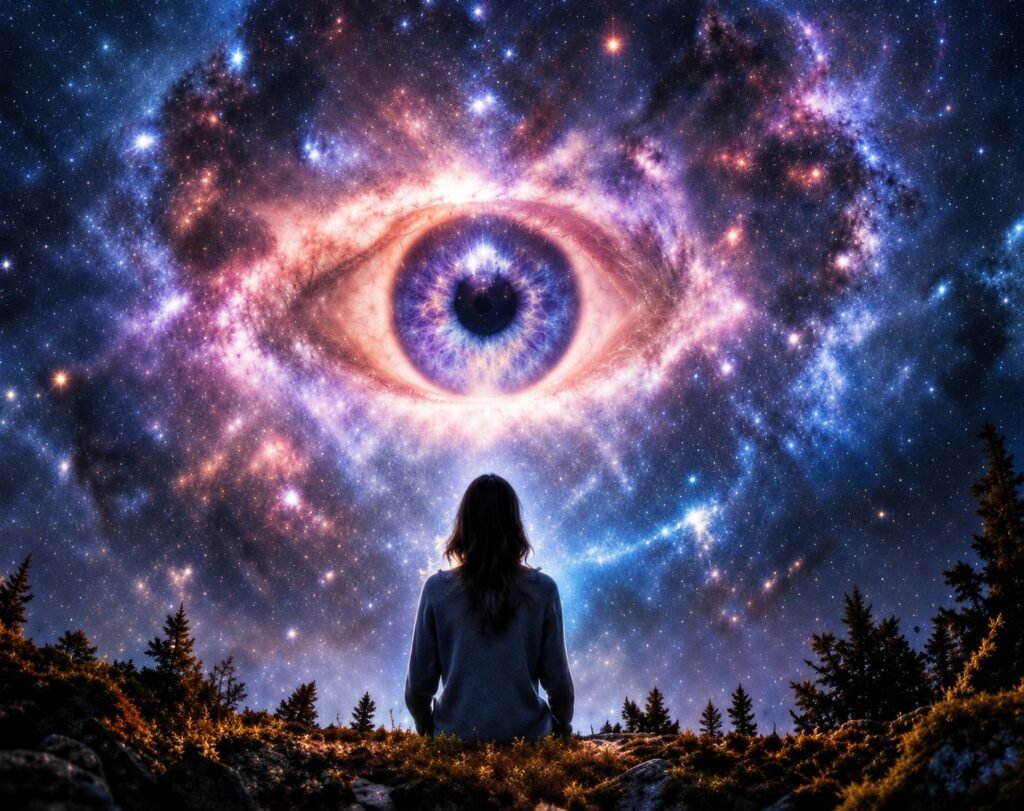
Third eye opening symptoms, explained honestly: what the third eye means, why pressure, lights and intuition feel so real, and which signs need a doctor.
It starts somewhere around the tenth minute of meditation. A faint pressure blooms between your eyebrows, as if someone has pressed a thumb gently against your forehead. Behind your closed eyes, a soft purple smudge drifts and pulses. You hold still, half thrilled and half unsure whether you should stop.
Later that night you search “third eye opening symptoms” and find a list. Forehead pressure: check. Headaches: check. Vivid dreams, sensitivity to light, trouble sleeping, strong intuition, feeling emotional, seeing colors: check, check, check. By the end of it, almost everything that has happened to you this month apparently counts as proof that your third eye is opening.
Part of you feels validated. Another part, the quieter one, wonders whether a list that explains everything really explains anything.
This article is for both parts of you. By the end you’ll know what the third eye has meant in the traditions it comes from, how its modern version was put together, why the sensations people describe can feel so vivid and convincing, and which experiences deserve curiosity, which deserve patience, and which deserve a doctor. You won’t be told your experiences are fake. You also won’t be told every headache is a spiritual upgrade.
At its simplest, the third eye is a symbol for a kind of seeing that goes beyond the physical eyes: insight, clarity, inner perception, the ability to see what’s really going on beneath appearances. It’s usually placed in the center of the forehead, just above and between the eyebrows.
That location shows up in several traditions, each with its own meaning.
The point between the eyebrows is associated with ajna, often listed as the sixth chakra. The Sanskrit word ājñā is usually translated as “command” (Chakra). The bindi and tilaka worn on the forehead are closely linked to this point, and many statues of deities and yogis show the gaze turned toward it during meditation.
The god Shiva is often depicted with a third eye, and the most famous story about it is worth knowing, because it isn’t about visions at all. When Kama, the god of desire, shoots a flower-tipped arrow to break Shiva’s meditation, Shiva opens his third eye and its fire burns Kama to ash (Museum of Fine Arts, Boston). In that story, the third eye isn’t a screen for pretty lights. It’s a fierce, clarifying power that cuts through distraction and illusion.
Buddhism has no single widespread “third eye” concept, but statues of the Buddha often show the ūrṇā, a mark between the eyebrows that is one of the traditional signs of an awakened being. Some Buddhist texts also describe a “divine eye,” a meditative faculty of extraordinary perception. Taoist and qigong practitioners often focus their attention on the space between the eyebrows to deepen concentration.
Christian contemplatives sometimes point to a line from the Gospel of Matthew, “if therefore thine eye be single, thy whole body shall be full of light,” as an image of undivided spiritual attention, although that reading is an interpretation rather than a doctrine of a third eye.
Notice what these traditions mostly have in common. The third eye stands for clearer seeing, reached through long discipline and concentration. It isn’t presented as a set of physical symptoms you can check off a list.
The version of the third eye you meet online today, with its indigo glow, its link to the pineal gland and its lists of activation symptoms, is much more recent than it looks. It’s a blend of ancient symbols and 19th- and 20th-century Western ideas.
In the 1600s, the philosopher René Descartes famously called the pineal gland, a tiny structure deep in the brain, the “principal seat of the soul.” He chose it partly because it was the only part of the brain he could find that wasn’t paired, so it seemed like a natural meeting point for a single, unified mind. His anatomy turned out to be wrong in several ways (Stanford Encyclopedia of Philosophy).
In the late 1800s, the founders of Theosophy, a movement that mixed Western esotericism with ideas borrowed from Hindu and Buddhist sources, took things further. Helena Blavatsky taught that early humans once had a literal third eye that later withdrew into the skull, leaving the pineal gland as its “witness.” That idea, more than any ancient text, is where the modern pineal-third-eye link comes from.
Chakra systems in Indian tantric traditions varied a great deal, listing anywhere from four to many more centers. The tidy seven-chakra model familiar in the West owes a lot to Sir John Woodroffe’s 1919 book The Serpent Power, a translation of a 16th-century Sanskrit text. In the 1920s, Western writers began pairing each chakra with an endocrine gland, and in 1927 the Theosophist C. W. Leadbeater assigned chakras the rainbow colors, which don’t appear in the ancient Indian systems (Chakra). The idea that the third eye is indigo is, in other words, less than a century old.
The final layer is the newest. Blogs, videos and social media turned the third eye into something you could self-diagnose, with lists of “activation symptoms” that grew longer over time. That’s the version most people meet first today, and it’s the version that causes the most confusion.
None of this makes the third eye meaningless. It means the symbol you’re working with has layers, and it helps to know which layer someone is talking about when they say “my third eye is opening.”
The pineal gland is real and does real work. Its best-known job is producing melatonin, a hormone that helps regulate your sleep-wake cycle (HealthDesk). In some reptiles and amphibians, a related structure called the parietal eye really is light-sensitive. But there’s no evidence that the human pineal gland opens, activates or develops new perceptual powers during meditation.
Pressure, tingling and headaches can come from many ordinary causes, from tensed forehead muscles to sinus congestion to eye strain. Treating every one of them as spiritual can mean missing simple fixes and, occasionally, something that needs medical attention.
Calcium deposits in the pineal gland are common and increase with age. Claims that fluoride in toothpaste or water “calcifies” the third eye, and that special diets or supplements reverse it, aren’t supported by evidence. Researchers don’t yet fully understand why the gland calcifies, and no treatment has been shown to reverse it (HealthDesk).
Some content implies that an “open” third eye brings clairvoyance, aura-reading or a higher spiritual status. There’s no scientific evidence for those abilities. And in the traditions this idea comes from, chasing special powers is often treated as a distraction from the real point of practice, not the goal of it.
Here’s the important part: the experiences people describe are usually real experiences. The pressure is really felt. The lights are really seen. The surges of insight really happen. What’s open to question isn’t whether you felt them, but what they mean. Several well-understood processes can produce them.
Try this right now. Put your attention on your left earlobe and keep it there for thirty seconds. You’ll probably start noticing warmth, tingling or a faint pulse that you weren’t aware of a moment ago. Nothing changed in your earlobe. Your attention did.
Many meditation techniques ask you to focus on the space between your eyebrows. When you do that for ten or twenty minutes, that area gets the same amplification. Add the fact that concentrating often makes people furrow their brow without realizing it, and you have a very plausible recipe for pressure, tingling and even a mild tension headache right where the third eye is supposed to be.
Lights during meditation have been described for centuries. Theravada Buddhist texts describe a nimitta, a light that can appear as concentration deepens, while Zen teachers call similar experiences makyo and treat them as distractions not to get attached to. A 2014 paper by Jared Lindahl, Willoughby Britton and colleagues explored these light experiences and proposed a neurological explanation: meditation resembles mild sensory deprivation, with a quiet room, a still body and closed eyes. When the visual system receives less input, its neurons can become more excitable and fire spontaneously, producing flashes, dots, colors, grids and a general brightening (Lindahl et al., 2014).
Those purple swirls behind your eyelids are, in that view, your visual system doing something interesting while it’s under-stimulated. That doesn’t make the experience trivial. It means you don’t need a hidden organ to explain it.
Many people meditate in the morning, at night or when tired. As you drift toward sleep, it’s common to see vivid images, faces, landscapes or geometric patterns, and sometimes to hear sounds or voices briefly. These are called hypnagogic experiences and they’re a normal part of falling asleep. During a long, relaxed meditation, you can slip into that borderland without noticing, and the images can feel startlingly real.
Meditation can genuinely sharpen your awareness of inner signals. A 2025 meta-analysis of 29 randomized trials found that mindfulness training modestly improved people’s self-reported awareness of internal body sensations (Treves et al., 2025). When you notice your gut tightening around a certain person, or catch a quiet sense of unease before you can explain it, that can feel like a new kind of perception. It’s often an old kind, finally getting heard.
If you’ve just read that third eye opening causes pressure, headaches and tingling, you’re more likely to notice those sensations and interpret them that way. That isn’t a sign of gullibility. It’s how attention and expectation work for everyone. Symptom lists don’t just describe experiences. They train you to find them.
You may have heard that the pineal gland releases DMT, a powerful psychedelic, and that meditation triggers it. That idea came from the psychiatrist Rick Strassman, who openly called it a hypothesis. Later research did find DMT and the enzymes to make it in rat brains, but in other regions as well as the pineal gland, and one of the researchers said plainly, “We don’t know what it’s doing in the brain” (Michigan Medicine). There’s currently no evidence that meditation releases DMT in humans.
The experiences are real. The explanations on the internet are where things get shaky.
Here’s a grounded look at the experiences most often listed as signs your third eye is opening, what’s usually going on, and when to look further.
Pressure or tingling between the eyebrows. Often the result of sustained attention to that spot plus tension in the forehead muscles. Usually harmless. Check in with a doctor if it’s persistent outside of meditation or comes with other symptoms.
Headaches. Common causes include muscle tension, dehydration, too much or too little caffeine, poor sleep, eye strain and sinus problems. A headache during or after meditation is rarely spiritual information. Frequent or unusual headaches are worth discussing with a doctor.
Lights, colors or patterns with eyes closed. Very common in meditation and well described in contemplative traditions. Usually harmless. New flashes or floaters in your vision while your eyes are open are a different matter (see the next section).
Vivid dreams. Meditation, stress, changes in sleep schedule and some medications can all make dreams more vivid or memorable. Interesting, not alarming.
Sensitivity to light or sound. Can happen with deep relaxation or intensive practice, and it’s also a feature of migraines and some illnesses. If it’s intense, sudden or comes with a bad headache, get checked.
Trouble sleeping. Late-night meditation, intensive retreats, stress and excitement can all disrupt sleep. Ongoing insomnia deserves attention in its own right, because poor sleep makes almost every other experience on this list more likely.
Stronger intuition or a sense of “knowing.” Often reflects sharper attention to subtle cues in your body and surroundings. Useful, but worth testing rather than trusting blindly.
Seeing auras or energy around people. Afterimages, peripheral-vision effects and the visual system’s response to staring can all produce glows or halos. There’s no scientific evidence that auras exist as a physical phenomenon.
This is the part most third-eye articles leave out, and it may be the most important part of this one.
Some head and vision symptoms need medical attention, whatever else you believe about them. According to the NHS, you should call emergency services or go to an emergency department if you have a headache that comes on suddenly and is extremely painful; comes with numbness or weakness in your face or body, confusion, drowsiness, or difficulty speaking, balancing, walking or remembering; comes with loss of vision; comes with a very high temperature, stiff neck or sensitivity to light; follows a head injury in the last three months; or comes with a seizure (NHS).
The NHS also advises getting urgent medical advice for a headache that comes with vision or eye problems or vomiting, or that gets worse when you cough, sneeze, bend down or exercise, and seeing a doctor if you get headaches regularly or they’re getting worse.
Vision changes have their own warning signs. A sudden increase in floaters, or new floaters with flashing lights, a curtain or shadow across your vision, or loss of side vision can mean a retinal tear or detachment, which is an emergency that needs prompt treatment (NHS eye leaflet).
Psychological experiences deserve the same care. Talk to a doctor or mental health professional if you’re:
Meditation-related difficulties are real and documented. The Varieties of Contemplative Experience study, led by researchers at Brown University, interviewed nearly 100 Western Buddhist meditators and teachers and documented a wide range of challenging experiences, some lasting days or months and a few much longer (Lindahl et al., 2017). That doesn’t mean meditation is dangerous for most people. It means that when something feels wrong, “it’s just your third eye opening” is not a safe default answer.
A spiritual explanation should never be the reason you skip a medical one.
Picture someone, let’s call him Dev, who starts meditating daily and soon notices a dull ache across his forehead. He finds a third-eye symptom list and feels a rush of excitement. For weeks he reads the headaches as progress, sits longer, focuses harder on the spot between his brows, and the headaches get worse. He starts to feel anxious and a little special at the same time.
Eventually a friend asks when he last had his eyes tested. It turns out Dev needs reading glasses, has been drinking far less water since starting a new job, and has been frowning in concentration through every session. With glasses, water and a softer forehead, the headaches fade. To his surprise, his meditation gets better too. It becomes calmer, less effortful, more honest. If anything “opened,” it was his willingness to look at what was actually happening.
Dev’s story points to the real problem with third eye opening symptom lists. They take ordinary experiences, the kind every human body produces, and turn them into evidence of spiritual advancement. That has a few costs.
It can delay care. Real problems get missed or dismissed. It can feed anxiety. People start scanning their bodies for signs, worrying when they appear and worrying when they don’t. It can make practice about status. Meditation turns into a race to collect experiences rather than a way of seeing more clearly. And it can leave people feeling like failures when they meditate for years without ever seeing a single purple swirl.
The traditions saw this coming. Zen’s word makyo exists precisely so practitioners won’t get hooked on visions and sensations. Many Theravada teachers treat striking lights as something to notice and set aside. Even in the Shiva story, the third eye doesn’t produce an experience. It destroys a distraction.
So here’s the honest position. Your experiences matter and deserve to be taken seriously. Some may be meaningful markers of deepening concentration. But the measure of a genuinely “opening” third eye, if you want to use that language at all, isn’t what you feel in your forehead. It’s whether you’re seeing yourself, other people and your life more clearly than before.
Before you interpret a sensation spiritually, check the basics: sleep, water, caffeine, screen time, posture, sinus congestion and whether you’re due for an eye exam. If a symptom is new, severe, persistent or on the warning lists above, see a doctor. This isn’t unspiritual. It’s responsible.
During meditation, check your face every few minutes. Let your eyebrows drop, your forehead smooth out and your jaw loosen. If you’ve been focusing intently on the space between your brows, try widening your attention to include your whole face, your breath or the room. Pressure often fades within minutes.
If colors, lights or images appear, notice them with interest, then return to your usual object of meditation. Don’t chase them or try to make them stronger, and don’t worry if they disappear. They’re weather passing through your practice, not the destination.
For a few weeks, jot down any notable experience along with the context: time of day, how much you slept, how long you meditated, what you’d eaten or drunk, and your mood. Patterns often appear quickly. Headaches may line up with late nights, or lights with long morning sits. Either way, you’ll learn something real.
When you get a strong hunch, write it down along with what you expect to happen, then check later. Over time you’ll get a sense of when your intuition tends to be reliable, perhaps about people or your own needs, and when it isn’t. That’s a more trustworthy way to develop inner knowing than assuming every feeling is guidance.
If experiences feel intense or unsettling, shift toward eyes-open practice, walking meditation, body scans or simply shorter sessions. Spend time outdoors and with people. Grounding isn’t a step backwards. It’s how insight gets integrated.
A qualified meditation teacher, especially one familiar with the challenges of practice, can help you make sense of unusual experiences. A therapist can help if experiences bring up fear, old memories or distress. You don’t have to interpret everything alone.
Every so often, ask yourself whether your practice is making you a little more honest, patient, kind and clear-eyed in daily life. Those are the signs that matter, and they don’t depend on any sensation in your forehead.
Go back to the image of Shiva for a moment. The third eye doesn’t open to show him something beautiful. It opens to burn away the arrow of desire that was pulling him out of himself. It’s an eye that sees through things.
That may be the most useful way to think about your own third eye. Not as a hidden organ waiting to be activated, or a checklist of symptoms to collect, but as a capacity you build slowly: seeing the story your mind is telling, the tension you’re carrying, the pattern you keep repeating, the truth you’ve been avoiding. Sometimes that kind of seeing comes with tingles and lights. Usually it doesn’t. It looks like a quiet moment of honesty, and then another.
If you’ve felt the pressure between your eyebrows or watched colors swirl behind your eyelids, you don’t have to dismiss it, and you don’t have to build your spiritual identity on it. You can hold it with curiosity, look after your body and mind, and keep practicing. The opening that matters most is the one that lets you see your life as it is.
If you’d like to keep exploring, our Meditation and Consciousness sections look at what happens in practice with the same mix of openness and care, including what to do when meditation brings up unexpected experiences.
I wanted to write the article I’d want a friend to read before going down a 2 a.m. rabbit hole of third-eye symptom lists. The experiences people describe deserve respect, and so do the bodies and minds having them. If something in your practice feels wonderful, enjoy it without needing it to mean you’ve arrived. If something feels wrong, trust that feeling enough to get it checked. Real spiritual clarity has never required ignoring either.
How to Find Your Purpose in Life When You Have No Idea What You Want Learn how to find your

The Coincidences We Remember—and the Thousands We Don’t Why do certain coincidences stay with us while thousands vanish? Explore selective

Is the Self Something the Brain Constructs? What Neuroscience Says About the “You” Behind Your Thoughts Is the self-something the

What Is a Spiritual Awakening? The signs, symptoms, stages and challenges of a spiritual awakening, and grounded ways to move
The Dark Night of the Soul: 13 Signs You’re in It—and What Actually Helps When your old identity, meaning, and

The Ego Death Nobody Warns You About: What Happens After the Spiritual High Fades Why do you feel depressed after