
Mysteries & Alternative Beliefs
The Coincidences We Remember—and the Thousands We Don’t
The Coincidences We Remember—and the Thousands We Don’t Why do certain coincidences stay with us while thousands vanish? Explore selective
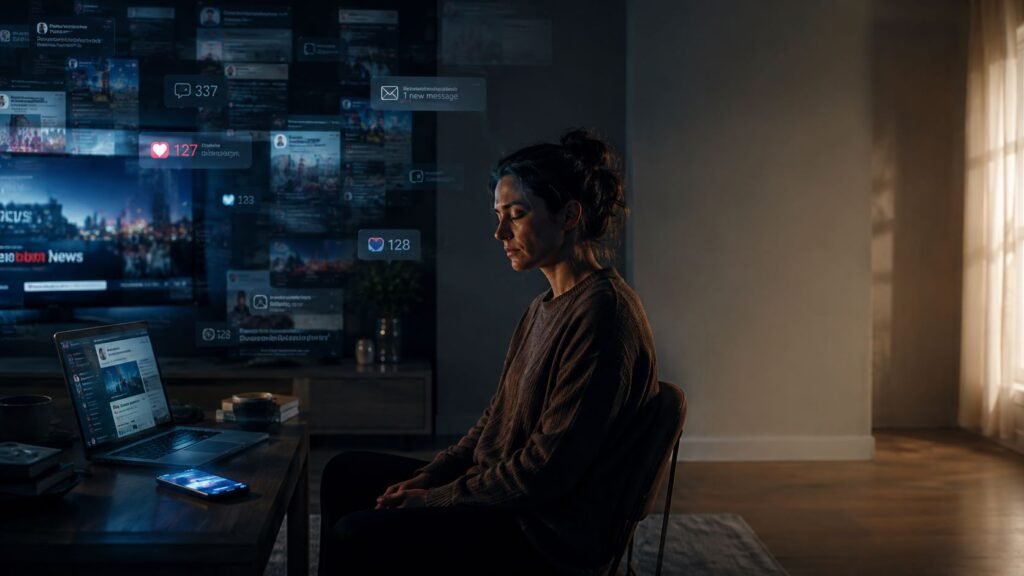
Feeling wired, foggy, irritable or unable to switch off? Learn 12 signs of overstimulation and how to reduce digital overload without quitting modern life.
You finally get into bed after a day that felt like twelve browser tabs arguing with one another.
Your brain is tired. Your eyes hurt. You have complained at least twice that you “just need some peace.”
So naturally, you pick up your phone.
One message becomes a news headline. The headline becomes a video. The video leads to comments. Somewhere between learning about a celebrity divorce you do not care about and watching a stranger reorganize a refrigerator you will never own, you realize another forty minutes have disappeared.
You put the phone down.
The room suddenly feels too quiet.
So you pick it back up.
This is one of the strangest features of chronic overstimulation: you can feel completely saturated with input and still reach for more of it.
You may become irritable, mentally foggy, indecisive, unusually sensitive to noise, incapable of finishing a thought, and exhausted by conversations that would normally feel easy.
Yet when nothing is happening?
You become restless.
If you’ve been wondering, Why do I feel overstimulated all the time?, this article will help you recognize the patterns behind that feeling, understand why modern attention gets exhausted so easily, and—most importantly—reduce the noise without pretending you can move to a monastery and communicate exclusively through handwritten letters.
Because the problem isn’t simply that you own a smartphone.
It’s that your mind may rarely get to experience a clean ending.
“Overstimulated” is one of those words people instinctively understand before they can define it.
Too much noise.
Too many conversations.
Too many decisions.
Too many tabs.
Too much news.
Too many people asking, “Quick question?”
Too many notifications arriving precisely when you’ve finally managed to think.
At its simplest, overstimulation describes a state in which the amount, intensity or persistence of incoming information feels greater than your current capacity to comfortably process it.
Researchers studying information overload use similar language: the problem emerges when the volume or intensity of information exceeds an individual’s limited processing capacity. Reported consequences can include confusion, difficulty making decisions, stress and reduced efficiency.
But information isn’t the only kind of input.
Your brain is constantly processing:
Modern life adds another layer: much of that information arrives in short, competing bursts.
You read half an email.
A message appears.
You answer it.
A headline catches your eye.
Someone asks a question.
Your smartwatch vibrates.
You return to the email and spend several seconds remembering why you opened it.
Nothing dramatic happened.
But your attention has changed lanes six times.
Do that hundreds of times and you begin to understand why a person can spend an entire day sitting in a chair and still feel as if their mind has been running through an airport.
Human attention is selective.
That is not a design flaw.
It is what allows you to read this sentence without consciously processing the pressure of your socks, the temperature of the room, every sound outside, every object in your peripheral vision and the exact location of your tongue.
Your brain filters.
Prioritizes.
Suppresses.
Switches.
Returns.
The problem is that every interruption competes for that system.
Phone notifications are particularly effective attention thieves because they don’t necessarily have to be answered to interrupt you. Experimental research has found that simply receiving a notification can disrupt performance on an attention-demanding task, even when people do not interact with the phone.
More recent research has similarly found small but measurable slowing of responses when smartphone notification sounds appear during cognitive tasks.
That does not mean every notification is causing neurological damage.
It means attention has a cost.
Every time something says:
Look here.
your brain has to decide whether to obey.
And sometimes resisting the interruption requires attention too.
This is why turning your phone face-down may help—and why hearing it buzz from across the room can still leave part of your mind wondering:
Who was that?
There is plenty of dramatic online language about technology “rewiring your brain” or “destroying your attention.”
The evidence is more complicated.
Research does suggest that smartphone interruptions can interfere with ongoing cognitive tasks and that heavy media multitasking is sometimes associated with poorer sustained attention or filtering of distractions. But findings about longer-term cognitive effects are mixed, many studies are correlational, and researchers explicitly caution against making sweeping causal claims.
In other words:
Your inability to read six pages of a book after spending two hours jumping between apps does not prove your brain has been permanently ruined.
It may simply mean you have been training one mode of attention all day and are now asking for another.
Fast switching.
Fast novelty.
Fast reward.
Fast reaction.
Then suddenly:
Chapter Three.
No notification.
No new tab.
No one dancing in the corner of the page.
Your mind says, Is something supposed to happen?
That is an important distinction because panic about your attention can become another source of stimulation.
You do not need to declare war on your brain.
You may simply need to give it fewer things to respond to.
Before we get to the signs of overstimulation, a few misconceptions are worth clearing up.
It isn’t necessarily a medical condition. “Overstimulation” and “digital overstimulation” are useful descriptive terms, not diagnoses you can confirm from an online checklist.
It isn’t always caused by screens. A loud workplace, caregiving, crowded environments, constant conversation, chronic pain, travel, intense social demands or prolonged stress can all create too much input.
It isn’t identical to anxiety. Anxiety can make you more sensitive to stimulation, and overstimulation can make you anxious, but the two aren’t interchangeable.
And it isn’t proof that you’re unusually fragile.
Sometimes the environment is simply asking too much attention from one human nervous system.
There’s nothing profound about being irritated after spending nine hours in meetings while twenty-seven notifications arrive and somebody is renovating the office above you.
Your brain may not need enlightenment.
It may need everyone to stop making noise for twenty minutes.
The microwave beeps.
Someone watches a video without headphones.
A dog barks.
The television is playing while somebody asks you a question.
And something inside you goes:
Absolutely not.
You know the sound isn’t objectively catastrophic.
But your tolerance for it seems to have vanished.
This is often one of the most recognizable signs of overstimulation: sensory input that you ordinarily tolerate begins feeling intrusive.
You may lower the radio while driving through an unfamiliar neighborhood.
Ask people to repeat themselves because two conversations are happening nearby.
Turn off music you would normally enjoy.
Become disproportionately irritated by tapping, chewing, alerts or background television.
The clue isn’t simply that you’re sensitive to sound.
The clue is that your threshold changes depending on how much input you’ve already processed.
At 9 a.m., someone’s loud conversation is mildly annoying.
At 6 p.m., after meetings, messages, traffic and twenty-seven minor decisions, the same conversation makes you contemplate becoming a lighthouse keeper.
Your capacity has changed.
Not necessarily the world.
You open your email to send a document.
There is a new message.
You read it.
It reminds you to check the calendar.
While checking the calendar, you remember you need to order something.
You open another tab.
Ten minutes later you’re looking at running shoes and vaguely aware that you originally came here for a reason.
What was it?
This is attention fragmentation in ordinary clothes.
Multitasking often feels productive because multiple tasks remain active in consciousness.
But what we casually call multitasking is frequently rapid task-switching.
Research on media multitasking has produced mixed findings about lasting effects, but there is much stronger reason to believe that interruptions and simultaneous demands can interfere with performance in the moment.
The lived experience is unmistakable:
You are busy all day but oddly unsure what you completed.
Lots of motion.
Very little closure.
Mental fatigue does not require solving differential equations.
You can become cognitively tired from making endless tiny selections.
Respond or ignore?
Click or don’t?
Save this?
Read later?
Which restaurant?
Which show?
Which headline is real?
Do I need this?
Should I answer?
Which version?
What did she mean by that message?
The modern mind performs hundreds of tiny acts of filtering and prioritization that barely register as “work.”
Eventually you may notice:
Names are harder to retrieve.
You reread sentences.
Simple calculations feel irritating.
You walk into rooms and forget why.
You struggle to organize thoughts that would normally come easily.
This kind of mental fog can have many causes—sleep loss, stress, illness, medication, nutritional issues and more—so it should not automatically be blamed on screens.
But when the fog reliably appears after hours of dense input and improves after genuine downtime, overload becomes worth considering.
“What do you want for dinner?”
You stare into the middle distance.
Food.
There are apparently kinds of it.
Normally this question would take twenty seconds.
Tonight it feels like you’ve been asked to redesign Canadian agricultural policy.
People often call this decision fatigue—the idea that repeated effortful decision-making can make later decisions harder or less effortful. Research into the phenomenon is still developing and effects vary substantially across contexts, so it should not be treated as a universal law of cognition.
But the subjective experience is familiar.
After a high-input day, choice itself can become irritating.
What should we watch?
Don’t care.
Where should we go?
You decide.
Which one do you prefer?
I genuinely cannot summon an opinion.
Sometimes the answer is not that you’ve become indecisive.
You may simply be depleted from deciding what deserves your attention all day.
Overstimulation doesn’t always announce itself as:
Hello. You have exceeded today’s recommended quantity of sensory input.
Sometimes it appears as:
“Why is everybody so annoying?”
Your patience gets shorter.
Interruptions feel personal.
Questions feel demanding.
A harmless request lands like another weight placed on an already overloaded shelf.
This can be confusing because you may not consciously feel stressed.
Nothing terrible happened today.
You simply processed more input than you had capacity for.
So your roommate asks, “Do we need milk?”
And your internal reaction is:
I CANNOT BE RESPONSIBLE FOR THE DAIRY SUPPLY CHAIN RIGHT NOW.
That intensity is information.
Instead of immediately concluding that you’re becoming a terrible human being, ask:
How much have I already processed today?
Irritability can sometimes be the smoke detector of mental overload.
You watch a film while scrolling.
Listen to a podcast while answering messages.
Eat while watching a video.
Work with seventeen tabs open.
Exercise while checking email between sets.
Even bathroom breaks somehow require content.
One activity no longer seems sufficient.
At first this feels efficient.
Then something subtle happens.
Single-tasking begins to feel strangely under-stimulating.
Research on media multitasking suggests that multiple factors may drive the behavior—including the environment, personal tendencies, task value and moment-to-moment motivations. It is not as simple as “people have become addicted to distraction.”
But habit matters.
If nearly every ordinary activity is paired with secondary stimulation, then doing one thing begins to feel unusually empty.
You haven’t lost the ability to wash dishes without YouTube.
You’ve simply stopped practicing it.
Here is one of the stranger signs.
You spend the entire day wanting everyone to leave you alone.
Then everyone leaves you alone.
And within thirty seconds, you reach for your phone.
Silence feels itchy.
Standing in a queue without stimulation feels pointless.
Waiting for the kettle takes too long.
You cannot simply sit in the car for two minutes.
This isn’t necessarily because quiet is unpleasant.
Quiet creates space.
And space allows whatever has been buried beneath the input to become audible.
Fatigue.
Boredom.
Worry.
Loneliness.
An unfinished conversation.
The vague suspicion that you actually don’t like something about your life.
Constant stimulation can become more than entertainment.
It can become emotional wallpaper.
Remove it and suddenly you see the wall.
This may be the defining paradox of digital overstimulation.
Your brain is tired.
Yet you want novelty.
One more video.
One more headline.
One more refresh.
One more episode.
One more scroll.
Why?
Because exhaustion and stimulation-seeking can coexist.
What you’re craving may not be additional information so much as relief from the discomfort of being understimulated after a day of constant novelty.
Think about how peculiar modern boredom has become.
You can access virtually the entire world’s music, news, arguments, disasters, comedy, pornography, shopping, education, gossip and entertainment from a rectangle in your hand.
Yet waiting three minutes for a friend can feel intolerably boring.
That should tell us something.
Our threshold for “nothing happening” has shifted.
And because high stimulation temporarily relieves boredom, we reach for more precisely when we may need less.
All day:
“I cannot wait to sleep.”
10:47 p.m.:
“Perhaps now would be a good time to investigate everything that has ever happened.”
You get into bed.
Open your phone.
And suddenly you’re wide awake.
Bedtime screen use and sleep have a complicated relationship, so simplistic claims such as “screens always ruin sleep” go beyond the evidence. A 2025 Canadian study, for example, found a more nuanced association depending on frequency, demographic factors and which dimension of sleep was measured.
At the same time, broader research has found meaningful associations between nighttime digital-media use and later sleep, poorer sleep outcomes or daytime fatigue, especially in younger populations and with problematic or bedtime-focused use.
But there is also a behavioural issue that has nothing to do with blue light.
Content has no natural ending.
Books have chapters.
Television programmes used to end.
Newspapers had a final page.
A social feed does not say:
That’s enough reality for today. Goodnight.
The stopping decision belongs to you.
And when you’re already mentally depleted, making another good decision at 11:36 p.m. is asking quite a lot.
Someone you love starts telling you about their day.
Normally you’d care.
Tonight you find yourself struggling to track the story.
You look interested.
Nod appropriately.
But internally you are thinking:
Please don’t introduce another character.
This can create guilt because it feels like emotional withdrawal.
Sometimes it is.
But sometimes your social bandwidth is simply gone.
Conversation requires attention.
You track words, facial expressions, tone, context, emotion, your own response and the meaning underneath what is being said.
When your cognitive system is already saturated, even enjoyable social interaction can feel demanding.
You may notice yourself wanting fewer questions.
Shorter conversations.
Less eye contact.
More silence.
Again, context is important. Persistent social withdrawal can accompany depression, anxiety, burnout and other difficulties.
But if your desire to disappear peaks after high-input days, overstimulation may be part of the picture.
You read ten headlines.
Watch six videos.
Listen to two podcasts.
Scroll through dozens of posts.
And later someone asks what you encountered today.
You remember remarkably little.
This is one of the quiet absurdities of information abundance:
Exposure is not the same as absorption.
Your mind needs enough uninterrupted attention to encode, organize and connect information.
Research examining smartphones and cognition has raised questions about associations between media habits, attention and memory, although the literature does not support simplistic claims that smartphone use automatically damages memory.
Still, the practical distinction matters.
There is a difference between learning and being repeatedly exposed to new things.
If you consume information faster than you can integrate it, you may end the day feeling mentally full while retaining very little.
Like eating continuously without digesting.
This may be the deepest sign of all.
You know what everyone else thinks.
The podcast host.
Your favourite creator.
The news commentator.
The wellness expert.
Your group chat.
The person making an angry video from the driver’s seat of a parked car.
But underneath all those voices:
What do you think?
Constant information consumption can make reflection feel like another form of consumption.
Something happens.
Before experiencing your own response, you search.
Read reactions.
Watch commentary.
Compare interpretations.
Find someone who explains what it means.
We have gained extraordinary access to information.
But information and wisdom are not identical.
Wisdom requires some empty space in which information can become understanding.
Without that space, you may become extraordinarily informed and strangely disconnected from your own perspective.
That isn’t simply digital fatigue.
It’s a loss of interior quiet.
No—and this distinction is important.
The experiences can overlap.
Someone with anxiety may feel hyper-alert and find sensory input harder to tolerate.
Someone with ADHD may experience distractibility, attention-regulation difficulties or stimulation-seeking that shouldn’t be reduced to “too much screen time.”
Burnout can produce exhaustion, reduced capacity and irritability.
Sleep deprivation can make concentration dramatically worse.
Migraine, autism, hormonal changes, medications, neurological conditions and many other factors can affect sensory tolerance or cognitive functioning.
So don’t use an article about the signs of overstimulation to diagnose yourself with something—or to talk yourself out of seeking help.
A useful question is:
Does reducing input reliably improve how I feel?
If several hours of genuine low-input time noticeably restores clarity, patience and attention, overstimulation may be contributing.
If symptoms remain intense, persistent or disruptive regardless of your environment, there may be more going on.
The goal is curiosity.
Not self-diagnosis.
It’s easy to blame technology.
Algorithms.
Notifications.
News.
Apps specifically engineered to keep us scrolling.
And yes, design matters.
But here is the uncomfortable part.
Sometimes nobody interrupts us.
We interrupt ourselves.
You are writing.
Nothing happens.
Then your hand reaches for the phone.
You are watching a film.
You voluntarily open another screen.
You are reading.
After two pages, you wonder whether you received an email.
Nobody asked you to check.
This is not a character flaw.
It is habit meeting easy access to novelty.
And it means that solving chronic overstimulation requires more than turning off notifications.
We have to become willing to experience something modern life has made surprisingly uncomfortable:
an unfilled moment.
No input.
No productivity.
No self-improvement.
No entertainment.
Nothing urgently needing interpretation.
That sounds easy until you try it.
Many people attempt a “digital detox” and quickly discover that removing stimulation does not immediately produce inner peace.
It produces boredom.
Restlessness.
An urge to check.
Thoughts.
Sometimes uncomfortable thoughts.
This does not mean the detox is failing.
You’ve removed something that was occupying attention.
Now attention has nowhere obvious to go.
Boredom can feel unpleasant precisely because the mind has grown accustomed to immediate novelty.
But boredom also creates conditions that constant input rarely allows.
Observation.
Daydreaming.
Reflection.
Creative association.
Noticing your surroundings.
Having an original thought without immediately checking whether someone else already posted it.
You don’t need to romanticize boredom.
You simply need to stop treating every second of it as a technical problem.
The solution is not necessarily “less technology.”
A person can spend two focused hours designing something on a computer and feel energized.
The same person can spend twenty fragmented minutes bouncing between email, social media, messaging and news and feel depleted.
So instead of obsessing over raw screen-time numbers, pay attention to how your attention is being used.
Here is where to begin.
Your phone does not need permission to interrupt you every time an app would like engagement.
Audit your alerts.
Ask:
Would I want a human being to tap me on the shoulder every time this notification appears?
Sale notification?
No.
Someone liked your photo?
Probably not.
Breaking-news alert about an event you cannot influence?
Perhaps not.
Email arriving?
Does email really need to function like a smoke alarm?
Keep alerts for things that genuinely deserve immediate attention.
Everything else can wait until you choose to look.
This changes the relationship from:
The device summons me
to:
I decide when I enter.
If you watch something, just watch it.
If you eat, occasionally just eat.
If you walk, sometimes walk without listening to anything.
If you talk to someone, leave the phone elsewhere.
At first this can feel inefficient.
Good.
Efficiency is not the goal.
You are practising sustained attention.
Start with ten minutes.
You do not need to become a contemplative monk before Thursday.
Not all silence needs to become meditation.
Try:
Five minutes after waking before touching your phone.
Ten minutes in the car without audio.
A shower without bringing your phone into the bathroom.
A walk around the block without headphones.
The first few minutes after work without television.
Standing in a queue without opening an app.
These moments look almost insultingly small.
That is their advantage.
They are sustainable.
And they restore something modern attention often lacks:
A gap between one thing and the next.
Background television.
YouTube while working.
Podcasts while answering messages.
News playing in another room.
Music with lyrics while trying to write.
You may believe you’re ignoring it.
But ignoring something still requires filtering.
Experiment with silence during cognitively demanding tasks.
Not forever.
Just compare.
How does your mind feel after one hour of focused work without secondary media versus one hour with several information streams competing?
Your own nervous system is useful data.
Instead of checking email forty times, check it at deliberate intervals where your responsibilities allow.
Do the same with messaging.
News.
Social media.
Administrative tasks.
The goal is not rigid productivity.
It is fewer transitions.
Every time you combine similar tasks, you reduce the number of times your mind must completely reorient itself.
You are creating longer stretches in which one context is allowed to remain one context.
That can feel remarkably spacious.
Move entertainment apps away from the home screen.
Remove badges.
Use grayscale if it helps you.
Log out of apps you open automatically.
Delete applications you can easily access through a browser.
Keep your charger outside the bedroom if that works for your household.
None of these tricks is spiritually profound.
That is precisely the point.
Sometimes environmental design works better than heroic self-control.
You don’t need more willpower if you can simply make the unwanted behaviour slightly more annoying.
At some point, stop learning about the world.
The world will continue overnight.
You are not personally responsible for supervising it.
Try creating an evening boundary for:
News.
Work email.
Arguments.
Social media.
Financial checking.
Highly stimulating videos.
This isn’t about pretending difficult things don’t exist.
It’s about acknowledging that your mind has biological limits.
There is very little useful action you can take on most international crises at 12:18 a.m. while lying sideways in bed.
Your first conscious act does not need to be absorbing other people’s priorities.
And your final experience before sleep does not need to be an algorithm asking whether you’d like one more thing.
Try creating bookends.
Morning:
Water.
Light.
Stretching.
Breakfast.
Five quiet minutes.
Anything before the feed.
Evening:
Lower stimulation.
Write tomorrow’s reminders down.
Dim the information environment.
Do something with an ending.
A chapter.
A shower.
A cup of tea.
A song.
Your nervous system understands transitions better when your environment contains them.
Sometimes you aren’t checking the phone because you’re bored.
You’re checking because you don’t want to feel something.
Anxiety before a task.
Loneliness.
Awkwardness.
Uncertainty.
A difficult thought.
The uncomfortable first five minutes of creative work.
Next time you automatically reach for stimulation, try asking:
What was I feeling one second before I reached?
Don’t make this a morality test.
Just notice.
Maybe the answer is simply boredom.
Maybe it isn’t.
That information can be more valuable than another screen-time statistic.
Many people respond to an overstimulating workday with an overstimulating evening.
Eight hours of screens.
Then three hours of different screens.
The content changes.
The mode does not.
Experiment with recovery that asks less attention from you:
Walking.
Stretching.
Cooking.
Gardening.
Drawing.
Taking a bath.
Sitting outside.
Simple music.
A slow conversation.
Petting an animal.
Cleaning something uncomplicated.
Doing absolutely nothing for ten minutes without attempting to become spiritually superior because of it.
The question is:
Does this activity leave my attention fuller—or emptier?
Completion is surprisingly calming.
Finish the paragraph.
Then check the message.
Finish the meal.
Then watch the video.
Finish the conversation.
Then look at the phone.
Finish one small task before opening another.
This sounds almost absurdly obvious.
Yet observe how often modern life trains the opposite behaviour.
Half-finished experiences create mental residue.
Completion gives the mind somewhere to put things.
Done.
Next.
Done.
Next.
There is relief in that rhythm.
Do not wait until everyone around you has become “annoying.”
By then, you may already be overloaded.
Learn your early signs.
Maybe yours are:
Jaw tension.
Rereading sentences.
Opening apps automatically.
Becoming impatient with questions.
Turning the radio down.
Difficulty choosing dinner.
Wanting everyone to stop talking.
That is the moment to reduce input.
Not four hours later after you’ve snapped at someone because they asked where the scissors are.
Overstimulation is easier to interrupt when you recognize the first five percent rather than the final ninety-five.
If your brain feels completely saturated right now, don’t redesign your entire digital life.
Try this.
For twenty minutes:
Put the phone somewhere you cannot casually reach it.
Turn off background media.
Drink some water.
Move slowly for five minutes—walk, stretch, step outside.
Then sit somewhere relatively quiet.
Do not try to meditate perfectly.
Do not optimize your breathing.
Do not play “relaxing sounds” while checking whether you’re relaxed yet.
Let your senses encounter fewer things.
Notice your surroundings.
Allow boredom.
Let your mind wander.
At the end, ask:
Do I feel even five percent less crowded inside?
That’s enough.
The point is not transformation.
It is contrast.
Sometimes you don’t realize how noisy your internal world has become until you briefly experience less noise.
Reducing input can be useful.
But not every problem can be solved by turning off notifications.
If persistent concentration problems, sensory sensitivity, anxiety, sleep disruption, irritability or cognitive fog significantly interfere with daily life, consider discussing them with an appropriate healthcare or mental-health professional.
Likewise, sudden cognitive changes, severe headaches, fainting, neurological symptoms, major changes in mood or functioning, or other concerning symptoms should not be casually attributed to “digital overstimulation.”
There is a dangerous side to wellness language when a useful framework becomes the only framework.
Sometimes you need quiet.
Sometimes you need sleep.
Sometimes you need psychological support.
Sometimes you need medical care.
Sometimes you need an ADHD assessment.
Sometimes you need to stop working twelve-hour days.
Holistic wellbeing means keeping all of those possibilities available.
It probably won’t feel extraordinary.
That’s what makes it easy to underestimate.
You read without checking.
Listen without simultaneously scrolling.
Finish a thought.
Notice you’re hungry before you’re ravenous.
Drive somewhere without needing entertainment every kilometre.
Have a conversation and remember it.
Stand in a queue without experiencing the urgent need to consume something.
You begin noticing pauses.
And the pauses stop feeling empty.
They begin feeling spacious.
This may be the part of digital wellbeing we talk about least.
We focus on what technology takes.
Attention.
Time.
Sleep.
Focus.
But perhaps the deeper question is what constant input prevents us from encountering.
The unoccupied mind.
The wandering thought.
The half-formed idea.
The emotion that needs a few quiet minutes before it can become intelligible.
The subtle realization that something in your life needs to change.
The sound of rain when you’re not simultaneously photographing it, posting it and reading what other people think about rain.
Not everything meaningful arrives as information.
Some things only become visible once information stops arriving.
You do not need to throw your phone into a lake.
This is expensive and environmentally questionable.
You do not need to abandon social media, reject technology or decide that humanity peaked before Wi-Fi.
Digital tools are extraordinarily useful.
They connect families.
Teach skills.
Create livelihoods.
Provide community.
Make knowledge accessible at a scale previous generations could barely imagine.
The issue isn’t whether modern technology is good or bad.
That question is too crude.
The better question is:
Who decides what gets your attention—and how often?
Because attention is more than a productivity resource.
It is the material from which experience is built.
Whatever repeatedly receives your attention gradually becomes the texture of your life.
If your days consist mostly of interruption, reaction, novelty and unfinished input, eventually your inner world may begin to resemble the environment feeding it:
fragmented.
busy.
crowded.
restless.
And if that is happening, the answer may not be another app designed to optimize your focus.
It may begin with something almost embarrassingly simple.
One thing.
Then another.
A message you don’t answer immediately.
A walk without headphones.
A meal without content.
An evening with fewer voices.
A quiet room you don’t immediately escape.
At first, your mind may protest.
It may reach automatically for stimulation.
Let it.
Then wait.
Because beneath the constant urge for something else to happen, there is another capacity most of us haven’t lost.
We’ve merely stopped exercising it.
The ability to stay.
To notice.
To finish.
To think.
To experience a moment without immediately asking it to become another moment.
Maybe the opposite of overstimulation isn’t silence.
Maybe it’s enough.
Enough information.
Enough input.
Enough urgency.
Enough for today.
And the strange thing about enough is that nobody’s phone will notify you when you’ve reached it.
You have to learn to notice for yourself.
Modern life gives us access to more voices, ideas, entertainment and information than almost any generation before us.
That’s an astonishing privilege.
It is also an attentional environment our habits are still learning how to navigate.
The goal isn’t to become afraid of stimulation.
It’s to recover choice.
To know when you want input—and when you are simply reaching for it automatically.
To notice when curiosity has become compulsion.
To recognize when connection has become interruption.
And occasionally to let absolutely nothing happen.
You may be surprised by how much of yourself becomes audible when the noise finally has somewhere else to be.
The Coincidences We Remember—and the Thousands We Don’t Why do certain coincidences stay with us while thousands vanish? Explore selective

Did You Sense Something Before It Happened? Why “Premonitions” Are So Difficult to Explain—and Even Harder to Test Premonitions can

The “7 Hermetic Principles” Aren’t Ancient Egyptian Teachings: The History Most Spiritual Websites Leave Out The 7 Hermetic principles aren’t

The Difference Between Enlightenment and Dissociation: A Guide for People Whose Meditation Practice Feels “Too Peaceful” Is your meditation practice

Holistic Wellbeing for Skeptics: What’s Actually Evidence-Based—and What Deserves More Questioning Is holistic medicine evidence based? We examine meditation, yoga,

What Is Manifestation, Really? A Grounded Guide to What It Can—and Cannot—Do What is manifestation, and does it really work?