

Personal Transformation
What Is My Purpose? 9 Clues That Your Life May Already Be Answering the Question
What Is My Purpose? 9 Clues That Your Life May Already Be Answering the Question Wondering what your purpose is?
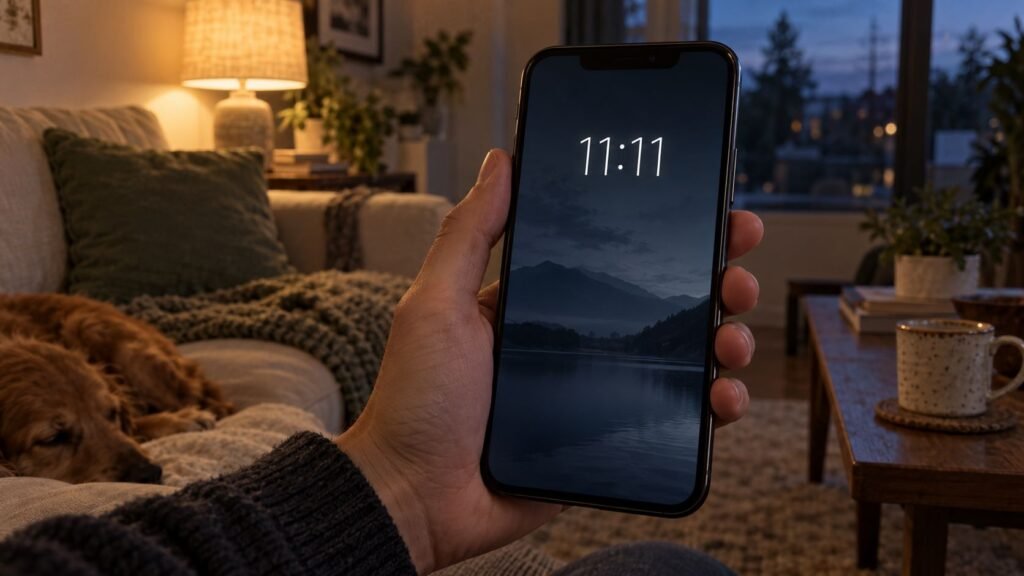
Why do you keep seeing 11:11? What psychology, numerology and history reveal about repeating numbers, and how a pattern can matter without being a message.
You pick up your phone to check something unimportant, and there it is: 11:11. Four identical strokes in a neat little row. It’s the third time this week, maybe the fifth. You feel a small jolt, half delight and half suspicion, and before you can stop yourself you’ve taken a screenshot.
Then you do what millions of people do and search “11:11 meaning.” Within seconds you’re told that angels are trying to reach you, that a portal is opening, that your twin flame is near, that you should make a wish, and that the universe is confirming you’re “on the right path.” The answers are confident and warm, and they contradict each other almost completely.
This article isn’t another angel-number dictionary. It’s an attempt to answer the question underneath the search: why do you keep seeing 11:11 at all? By the end you’ll understand what your brain is doing when a number seems to follow you around, where the spiritual meanings of 11:11 actually came from, what the evidence does and doesn’t support, and how to keep the moment meaningful without having to believe anything you don’t.
You don’t have to choose between “it’s a sign from the universe” and “it’s nothing, you’re being silly.” There’s a more interesting answer between those two, and it says as much about you as it does about the clock.
Start with something simple. Most times on a clock are visually forgettable. 10:47 means nothing to you. 3:26 slides past without a flicker. Your brain sees them, reads them, uses them and discards them within a second or two.
11:11 is different, and not because it’s mystical. It’s perceptually loud. It’s symmetrical, it repeats, and it looks like a pattern rather than a quantity. Our visual system is built to notice symmetry and repetition quickly, because in nature those features often mean something: a face, an animal, a structure someone made. A row of identical digits stands out against the visual noise of ordinary numbers the way a perfectly straight line stands out in a forest.
So the first part of the answer is that 11:11 gets noticed in a way other times don’t. The second part is even more important: it gets remembered.
Think about how many times you looked at a clock yesterday. Twenty? Fifty? More, if you count every glance at your phone’s lock screen. You remember almost none of them. You don’t remember the 2:38 or the 9:14 because nothing about them was worth keeping. But the time you saw 11:11, you remember, perhaps along with what you were thinking about, who you were with and how it felt.
That creates a lopsided record in your memory. Every hit is saved, and the thousands of misses disappear. When you look back, it genuinely seems as if 11:11 keeps appearing, because those are the only clock-moments you kept.
You don’t remember the 10:47s. That’s why the 11:11s seem to be everywhere.
There’s a name for the experience of noticing something once and then seeing it constantly. The Stanford linguist Arnold Zwicky called it the frequency illusion in 2005. It’s also known as the Baader-Meinhof phenomenon, after a 1994 letter to a Minnesota newspaper from a reader who heard the name of that German militant group once and then kept running into it.
Zwicky described two processes working together. The first is selective attention: once something matters to you, your mind starts flagging it automatically. You know this from everyday life. Learn a new word and you hear it twice in the same week. Start thinking about buying a certain car and suddenly that model is on every street.
The second is confirmation bias: once you suspect something is happening often, you start collecting examples that fit and quietly ignoring the ones that don’t. The car doesn’t become more common. Your filter changes.
With 11:11, the filter widens in a way that’s easy to miss. Once repeating numbers feel significant, it isn’t only 11:11 that counts anymore. A receipt total of $11.11 counts. So does 1:11, the address 111, the 11th of the month, flight 1111, a phone battery at 11 percent. The statisticians Persi Diaconis and Frederick Mosteller, who studied coincidences seriously, pointed out that counting “close” matches dramatically increases how many coincidences you’ll find (Diaconis & Mosteller, 1989). Every new thing you allow to count makes the pattern look stronger, without the world having changed at all.
Before going further, it helps to clear away a few ideas that tend to come bundled with this experience.
Noticing 11:11 often tells you something real about your attention, and possibly about your state of mind. It doesn’t, by itself, tell you that an outside intelligence arranged for you to look at the clock. Everything in the experience can be explained by ordinary perception and memory. That doesn’t rule out other beliefs, but it means the number can’t serve as proof of them.
The skeptical response can be just as lazy as the mystical one. Noticing repeating numbers is what a healthy human brain does. The same machinery that makes 11:11 jump out at you lets you spot a friend’s face in a crowd or hear your name across a noisy room. You’re not being foolish. You’re being human.
Angel-number websites present meanings for 11:11, 222 or 444 as if they were settled facts. Compare a few of them and you’ll find they disagree, sometimes completely. As the next sections show, most of these meanings are recent inventions, not ancient knowledge passed down intact.
There’s a quiet status game in some spiritual spaces where frequent number sightings are treated as proof of being spiritually advanced or “on the right path.” But as you’ll see, people may notice patterns more when they feel less in control, not more. A spike in 11:11 sightings can just as easily mean you’re stressed and searching as that you’re aligned.
In 1958 the German psychiatrist Klaus Conrad coined the word apophenia to describe the experience of seeing meaningful connections where none exist, accompanied by a strong feeling of significance. He was writing about the early stages of psychosis, but the term has since broadened to describe something everyone does to some degree. In 2008 the writer Michael Shermer gave it a friendlier name: patternicity, the tendency to find meaningful patterns in meaningless noise.
The usual explanation is evolutionary, and it’s intuitive. Imagine an early human hearing a rustle in the tall grass. If she assumes it’s a predator and it turns out to be the wind, she’s lost a few seconds and some dignity. If she assumes it’s the wind and it turns out to be a predator, she may not get a second chance. Over a long time, brains that leaned toward seeing patterns (even false ones) had an advantage over brains that waited for certainty. We’re descended from the jumpy ones.
So your mind is tuned to err on the side of “that means something.” It would rather catch ten false patterns than miss one real one. A row of identical digits is exactly the kind of signal it’s built to flag.
One of the most striking findings in this area came from a 2008 study in the journal Science. The psychologists Jennifer Whitson and Adam Galinsky ran a series of experiments in which some participants were first made to feel a lack of control. Afterward, those participants were more likely to see images hidden in pictures that were actually random noise. In one experiment they “saw” something in 43 percent of pictures that contained nothing at all. They were also more likely to perceive conspiracies and to believe in superstitious rituals (Whitson & Galinsky, 2008).
Then the researchers did something hopeful. When participants who felt out of control were given a chance to reflect on a value that mattered deeply to them, the effect went away. Their perception became no different from that of people who had never lost control at all.
The study didn’t look at clocks or numbers, so it would be overreaching to say it explains 11:11. But it fits something many people describe: the sightings cluster around breakups, job changes, grief, moves and long nights of not knowing what comes next. When the ground feels unsteady, the mind reaches harder for order. A neat row of ones can feel, for a second, like the world is still arranged.
Sometimes seeing 11:11 says less about the universe than about how badly you want something to make sense right now.
Here’s the part most articles on this topic skip, because it’s less romantic. Let’s actually do the math.
On a 12-hour clock, 11:11 appears twice a day, for one minute each time. That’s 2 of the 1,440 minutes in a day, or about 0.14 percent. If you glanced at a clock 60 times a day at random moments, which is easy with a phone in your pocket, you’d have roughly an 8 percent chance of catching 11:11 on any given day. Over a month, you’d expect to see it two or three times by chance alone.
Now widen the net the way the frequency illusion does. Suppose a dozen times “count” as special: 1:11, 2:22, 3:33, 4:44, 5:55, 10:10, 11:11, 12:12, 12:34 and a few others you’ve started noticing. Each appears twice a day, so that’s 24 special minutes out of 1,440. With the same 60 glances a day, the chance of seeing at least one “meaningful” time on any given day rises to about 64 percent. Most days, in other words.
And the glances aren’t truly random. If you take a break at the same time every morning, or check your phone every night as you settle into bed around 11, you’ll land on the same handful of minutes again and again. Habits create patterns that look like messages.
Diaconis and Mosteller summed up the principle in what they called the law of truly large numbers: “With a large enough sample, any outrageous thing is likely to happen” (Diaconis & Mosteller, 1989). Across a lifetime of glancing at screens, seeing 11:11 over and over isn’t outrageous at all. It would be strange if you didn’t.
If the psychology explains why you notice the number, history explains why it feels loaded once you do. The spiritual meaning of 11:11 isn’t ancient in the way it’s often presented. It’s a layered, mostly modern story.
The ancient Greek Pythagoreans are often credited with the idea that numbers aren’t just tools for counting but somehow underlie the order of the cosmos. Aristotle, writing later, described them as treating numbers as the principles of all things. Similar intuitions run through many traditions, from Jewish gematria, which reads meaning into the numerical values of Hebrew letters, to the sacred numbers of Hindu, Chinese and Christian cosmology. Humans have long suspected that numbers carry more than quantity.
Most of what people now call numerology took shape in the early 20th century, not in ancient Greece. An American writer named L. Dow Balliett, who published in the early 1900s and claimed her system was “as taught by Pythagoras,” is widely credited with shaping modern Western numerology, including the idea of “master numbers”: 11 and 22, which aren’t reduced to a single digit the way other numbers are. The number 33 was added later. Even the word “numerology” seems to date only from around the 1910s (numerology bibliography). So when a website says 11 is a “master number of spiritual illumination,” it’s drawing on a tradition roughly a century old, built on a much older philosophical idea.
11:11 as a specific spiritual signal emerged in New Age circles in the late 20th century. A teacher who went by the name Solara published 11:11: Inside the Doorway in 1992, framing the number as a gateway to higher consciousness. The idea of “angel numbers” came later still. Most accounts credit Doreen Virtue, whose book Angel Numbers appeared in 2005, followed by the bestselling Angel Numbers 101 in 2008, with popularizing the idea that guardian angels communicate through repeating digits. In 2017 Virtue publicly renounced her New Age beliefs after converting to Christianity (Doreen Virtue). The concept she popularized has carried on without her, spreading through blogs, apps and, especially, social media.
There’s one more ingredient that’s easy to overlook. For most of human history, nobody saw “11:11” at all. Analog clock hands don’t display a row of identical digits. The number only became a daily visual event once digital clocks, and later phones, put the time in front of us in that exact format dozens of times a day. In a very real sense, the modern 11:11 experience is something our screens made possible.
There are older resonances too. The First World War armistice took effect at the eleventh hour of the eleventh day of the eleventh month of 1918, which is why 11/11 still carries weight in many countries. And for generations of children, making a wish at 11:11 has been a small, private ritual. Meaning tends to collect around numbers that are easy to notice.
None of this makes the meanings fake. It makes them human. People built them, shared them and found them useful. Knowing that lets you hold them more lightly, and choose which ones you actually want to keep.
If you want a serious framework for meaningful coincidences, the best-known one comes from the Swiss psychiatrist Carl Jung. He used the word synchronicity for coincidences that feel deeply meaningful but have no obvious causal link. He developed the idea over decades, partly in conversation with the physicist Wolfgang Pauli, and set it out in his 1952 essay Synchronicity: An Acausal Connecting Principle (IAAP).
His most famous example involved a patient who was describing a dream about a golden scarab, a piece of jewelry, when Jung heard a tapping at the window. He opened it and caught a scarab-like beetle trying to get in, then handed it to her. For a patient whose rigid rationalism had stalled her therapy, Jung said, the moment broke something open.
Jung’s idea was bold, and science hasn’t supported the claim that there’s an “acausal” force linking inner and outer events. But one part of his thinking holds up well and is worth keeping: the significance of a coincidence lies in the meaning a person brings to it. The beetle mattered because of where the patient was in her life.
Modern research has started to look at this from a psychological angle. In 2023, the psychologists Russo-Netzer and Icekson published a scale measuring how often people notice coincidences and how much meaning they find in them. People who found more meaning in coincidences also tended to report more meaning in life and more optimism, and both were linked with higher life satisfaction (Russo-Netzer & Icekson, 2023). The study was correlational, so it can’t show that noticing coincidences causes wellbeing. But it suggests that the habit of finding meaning in small moments goes along with a richer inner life, at least for some people.
That’s the generous interpretation, and it doesn’t require believing in angels or portals. It only asks you to take your own attention seriously.
Here’s where most content on this topic goes wrong, in one of two opposite directions.
The first mistake is making the number carry too much weight. When 11:11 becomes a message, it’s a short step to letting it make decisions. People describe staying in relationships because the numbers “confirmed” it, quitting jobs after a string of 444s, or feeling anxious and abandoned when the numbers stop appearing. The number becomes an oracle, and an oracle that only ever says “yes, keep going” isn’t guidance. It’s an echo. It can also become a compulsion, a habit of checking the clock hoping for reassurance.
Remember where the word apophenia came from. For a small number of people, an intense, growing sense that ordinary things are carrying special messages meant for them alone isn’t a spiritual awakening. It can be an early sign that the mind is under real strain. If number sightings start to feel urgent, frightening or all-consuming, or come with other experiences that feel out of your control, that’s a reason to talk to a doctor or mental health professional, not a reason to search for deeper meanings.
The second mistake runs the other way. Some skeptics treat the explanation as if it were a verdict, as though knowing about confirmation bias means the moment can’t matter. That’s like saying a sunset is meaningless because it’s “just” light scattering through the atmosphere. Understanding how something works doesn’t cancel what it means to you.
So here’s an honest position. The psychological explanations are strong, well-supported and probably sufficient to account for why you keep seeing 11:11. You can’t prove that nothing else is going on, and no article can. But you also don’t need the number to be a message for the moment to be useful.
The pattern happens in your brain. The meaning happens in your life. Only one of them is up to you.
Meaning isn’t something you have to receive from outside. It can be something you decide on, deliberately, with your eyes open. That’s not a lesser version of spirituality. For many contemplative traditions, it’s closer to the real thing.
If you like the moment when 11:11 catches your eye, you don’t have to give it up. You can turn it into something more useful than a screenshot.
In some Buddhist monasteries a bell rings throughout the day as a cue to pause and come back to the present. 11:11 can do the same job. When you notice it, take one slow breath, feel your feet on the floor, and notice what’s actually happening around you. The number becomes a reminder to be here, not a riddle to solve.
This is the single most interesting thing you can do with a number sighting. In the second before you noticed 11:11, what was on your mind? Over a few weeks, you may find that sightings cluster around certain worries, people or decisions. The number isn’t telling you anything, but your attention might be, because you tend to look up and notice the world during particular kinds of moments.
If you’re curious whether 11:11 is following you, test it. For one month, every time you notice a “special” time, write down the time, what you were doing and how you were feeling. If you’re feeling thorough, also tally a few ordinary glances, like 4:52 or 9:07. At the end, look at what you have. You may find the sightings line up with your routines, or with stressful weeks. Either way, you’ll have learned something real about yourself, which is more than any angel-number chart can offer.
Pick one thing 11:11 will mean for you and keep it simple. It might be a moment of gratitude, a check-in with your intention for the day, a quick message to someone you love, or the childhood wish. A meaning you chose deliberately is sturdier than one you borrowed from a website, because it doesn’t depend on believing anything you don’t believe.
Use 11:11 as a prompt to think, not as a verdict. If you’re weighing a big choice, the number can remind you to slow down and ask what you actually value. It shouldn’t replace the slower work of honest reflection, good information and conversations with people who know you.
If you catch yourself glancing at the clock hoping for 11:11, or feeling uneasy when you don’t see it, that’s worth paying attention to. Ask yourself what you’re hoping the number will tell you. Often the answer points to something you need more directly, like reassurance, support or a decision you’ve been avoiding.
Picture someone, let’s call her Maya, in the hardest year she’s had in a while. A relationship has ended, her work feels uncertain, and she keeps seeing 11:11. At first she reads every sighting as proof that things will work out. Then, on a bad night, she sees it again and feels almost angry: if the universe is sending signs, why does everything still hurt?
Eventually she tries something different. Each time she sees 11:11, she stops and asks herself one question: What do I need right now? Some nights the answer is sleep. Some days it’s calling her sister. Once it’s an honest admission she’d been avoiding for months. The number never told her anything. But it kept giving her a moment to listen to herself, and that turned out to be what she needed.
That’s the strange appeal of 11:11. The remarkable thing isn’t that a clock showed four ones in a row. Clocks do that twice a day. What’s remarkable is that, for a second, you looked up from autopilot and noticed. You were paying attention.
You can call that a sign if you want to. You can also call it what it is: a small, recurring invitation to be present in your own life. Either way, the next time 11:11 catches your eye, you get to decide what happens next.
If you want to keep exploring experiences like this one, our Alternative Beliefs & Mysteries section looks at synchronicity, intuition and other extraordinary experiences with the same mix of curiosity and care.
I’ve tried to write the article I wished existed the first time I searched this question: one that takes the experience seriously without asking you to switch off your critical thinking. If seeing 11:11 has brought you comfort, I don’t want to take that away. I only want to give it firmer ground. A moment doesn’t have to be a message from beyond to be worth something. Sometimes the most spiritual thing a number can do is remind you to look up.
What Is My Purpose? 9 Clues That Your Life May Already Be Answering the Question Wondering what your purpose is?

Are Premonitions Real? What We Know, What We Don’t—and Why the Experience Can Feel So Convincing Are premonitions real? Explore

12 Levels of Consciousness Explained—Without the Mystical Jargon What if consciousness isn’t something you either “have” or “don’t have”—but something

The Healing Power of Doing Less: What Happens When You Stop Treating Every Moment as a Chance to Improve Slow

Sacred Geometry: Ancient Spiritual Insight, Mathematical Pattern — or Modern Projection? What is sacred geometry, really? The real history behind
The Dark Night of the Soul: 13 Signs You’re in It—and What Actually Helps When your old identity, meaning, and